I have always been drawn to the intersection of faith and intellect, the place where our deepest convictions meet the rigorous scrutiny of reason. And just yesterday, after watching two videos on TikTok, I found myself captivated by a concept known as Agrippa’s Trilemma: A philosophical thought that suggests human knowledge is built on a foundation of sand. It says that in every discussion, debate, or line of reasoning, it is technically impossible to prove that you are “right.” At first glance, this was just funny to me, very very funny; this thought feels like a direct assault on the absolute truths we hold dear in our walk with realities and for some of us, also our walk faith. It feels like an invitation to a world of total moral relativity where nothing is certain.
But, as I sat with this trilemma this very morning, I began to see it not as a denial of Truth, but as a profound tool for intellectual humility. I am of the opinion that the Trilemma does not exist to tell us that right and wrong do not exist; rather, it exists to test the quality of our knowledge and the integrity of our arguments. It reveals that while Truth is objective and eternal, our human attempts to grasp and prove it are so often flawed, circular, or grounded in pride and ego. And so, to understand Agrippa’s Trilemma is to understand that we must stop defending our image and start pursuing the Truth with a value that is both bold and deeply reflective.
The Three Walls of Human Reason
To engage with this thought, I had to look at the three walls that Agrippa says every argument eventually hits. The first is Infinite Regress; this is the endless “Why?” If I say something is true because of “A,” and you ask why “A” is true, I point to “B.” This continues forever; it is an exhausting, bottomless pit that shows we can never reach the final, ultimate proof through logic alone. The second is Circular Reasoning, where we prove a point by relying on the point itself. We see this often in religious circles: “The Word is true because it is from God, and we know it is from God because the Word says so.” While the conclusion may be true, the logical structure is a closed loop that offers no entry point for a seeking mind. And trust me, I am a Christian, I am just giving an example of what circular reasoning looks like.
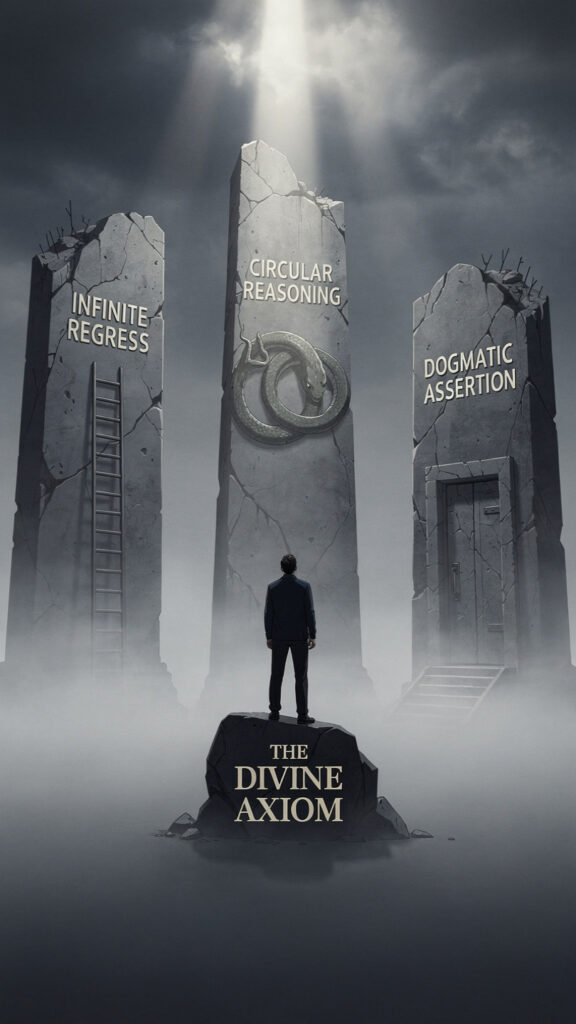
And the third wall is the Dogmatic Assertion, or the Axiom, and this is the point where we simply stop arguing and say, “It just is.” We decide that a certain truth is self-evident and requires no further proof. In philosophy, this is seen as a “logical failure,” but in the life of a believer, this is actually where the foundation is laid. The Trilemma forces us to admit that at the very base of everything we believe, whether we are atheists, scientists, or Christians, is a choice to believe in a starting point that can not be “proven” by the rules of the system itself. It humbles us by showing that our logic is not as self-sufficient as our ego would like to believe.
Testing Knowledge, Not Denying Truth
And I want to be very, very clear here, and maybe I am speaking for myself: Acknowledging the Trilemma is not the same as saying there is no right or wrong. On the contrary, there is an absolute moral law and a divine reality that governs the universe, and here we are again, maybe I am just speaking for myself. Right and wrong are as real as the gravity that keeps our feet on the ground; the value of Agrippa’s thought is that it acts as a fire that consumes “Mount Stupid,” that place of overconfidence where we think we know everything and have nothing left to learn. It tests our arguments to see if they are built on sound character or merely on a desire to win a debate.
So this morning, as I write and try to apply this to my own life, I realize that many of the things I have fought for are not actually “Truth,” but my own interpretation of it, and flavored by my ego.
The Divine Axiom: Where Reason Meets Faith
I hope this makes sense for all of my readers, but I am sure it will for my Christian readers, and this is it: The Divine Axiom, as I would like to call it. The beauty of the Trilemma is that it eventually leads us to the “Divine Axiom.” Since every line of reasoning must eventually stop at a starting point, an “It just is,” we must be intentional about what that starting point is. For me, that starting point is Christ; it is the axiom that God is love, that He is just, and that His Word is the bedrock of reality. This is not a blind faith that ignores logic, but a path, a light, a walkway that uses logic to explore the vastness of a truth that was already there.
We test our knowledge not to destroy it, but to purify it. By recognizing that our human debates are more often than not just contests of charisma or status, we can and we should step out of the arena of ego and into the sanctuary of wisdom.
We stop trying to be just right and start trying to “be truer.” We accept that while we see through a glass or a lens, and hopefully, the lens is God’s word. Agrippa’s Trilemma is a reminder that the loudest voice in the room is not necessarily the truest; it is a call to be the person who listens, learns, and remains open to the correction and, most importantly, the correction from the Spirit of God’s word, at least for us believers.
From the beginning of time everyone has always had an opinion about something or someone, and only a few pause to ask whether their opinions are reasonable. We have always lived in a time of emotion-driven conclusions and confirmation bias disguised as conviction, but if truth exists, and it does; then it must have rules. And those rules are found in the discipline of logic: The very structure of reason itself.
Before we can talk about truth, morality, or meaning, we must understand how we think and whether our thinking follows the laws that make truth even possible, because reason, like gravity, does NOT bend for opinion or belief.
And that begins with the laws of logic; the timeless principles that guide every true statement and every sound argument.
Continue Reading: Truth Has Rules: The Basic Laws of Logic and Objective Thinking
Read Also: Stop Holding Contradictory Beliefs: A Lesson from Russell’s Paradox
Read Also: Philosophical Razors That Will Sharpen Your Mind | Critical Thinking
Read Also: The Higher Law: How the Law of Life Sets You Free
Conclusion
Agrippa’s Trilemma can be seen as a gift to the person who values growth over pride. It can and should remind us that we are finite beings trying to understand an infinite world and an infinite God. It teaches us that our worst sin is often the betrayal of our own potential through the arrogance of thinking we have already arrived. Right and wrong exist, and they are worth living and dying for, but we must never let our knowledge become a wall that prevents us from seeing the person in front of us.
Let this philosophical thought weigh on your heart not as a burden of doubt, but as a shield against the Lucifer Effect of intellectual pride. Use it to test your arguments, to refine your speech, and to guard your heart against the seduction of being “right” for the sake of your image, but instead for the sake of righteousness. And so, my dearest readers, let us build our lives on the Divine Axiom, and let our character be the proof that maybe logic could never quite reach. So stand firm in the Truth, but walk in the humility of one who knows that the journey toward that Truth is eternal.