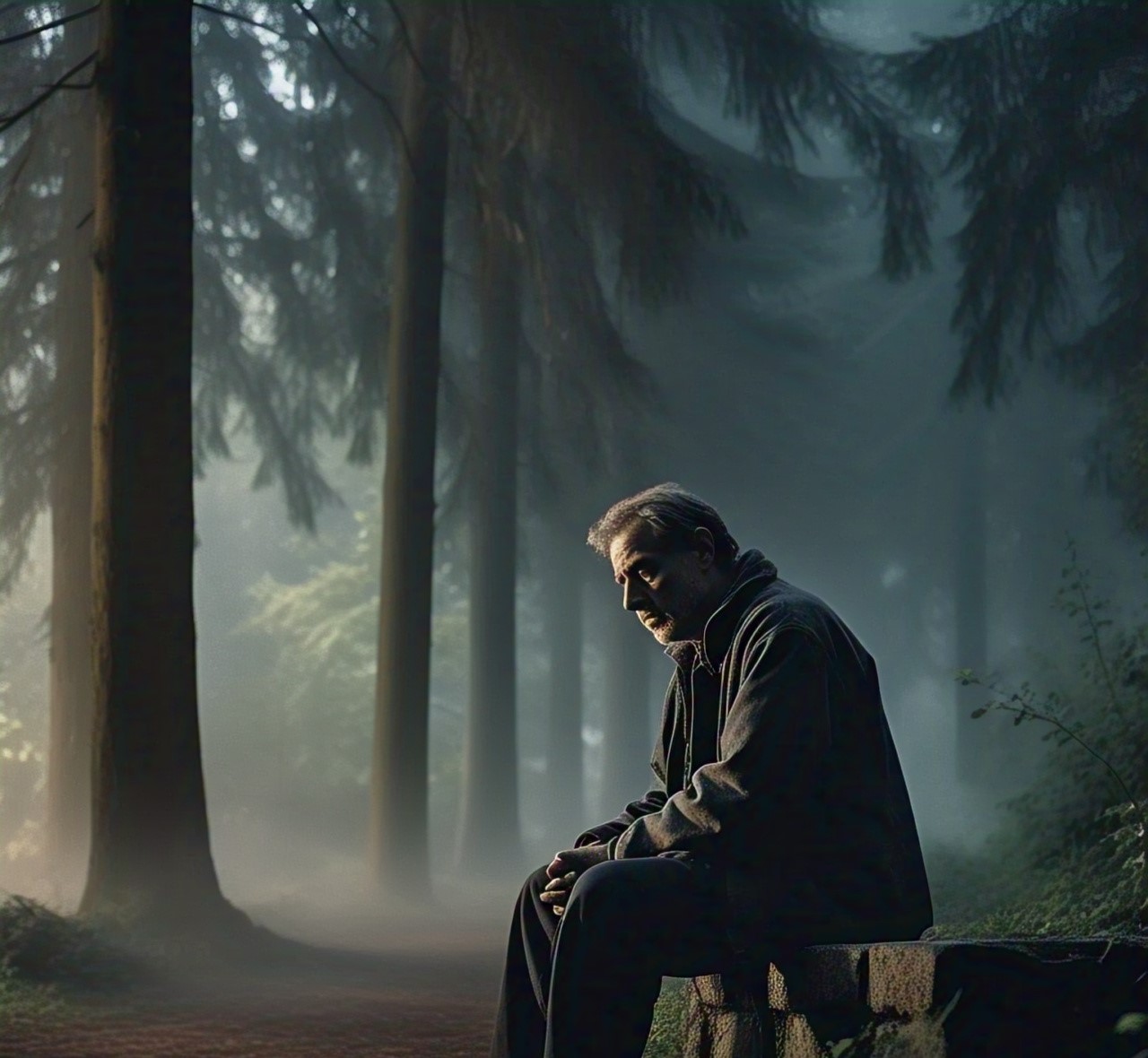
Obviously we all like to believe that we are rational, clear thinkers; that our decisions are guided by truth, by logic, and accurate perception. But the reality is far more fragile: Our minds are wired to see what we already believe and ignore what challenges us.
This natural but dangerous mental habit is called confirmation bias.
It is one of the most persistent cognitive traps in human thinking, and it quietly steals clarity, honesty, and growth from our lives.
To see clearly, you must learn to look beyond what confirms you.
What is Confirmation Bias?
Confirmation bias is the tendency to:
- seek information that supports your existing beliefs
- ignore information that contradicts them
- remember only the evidence that favors you
- and dismiss or downplay evidence that challenges you
It is human nature to prefer being comfortably wrong than uncomfortably right.
In psychology, this is described as a form of mental “filtering.” Your mind becomes selective, giving weight to what pleases you and silencing what confronts you. And this is why two people can see the same event and come away with completely different interpretations: They were not looking at the event objectively; they were looking through their beliefs.
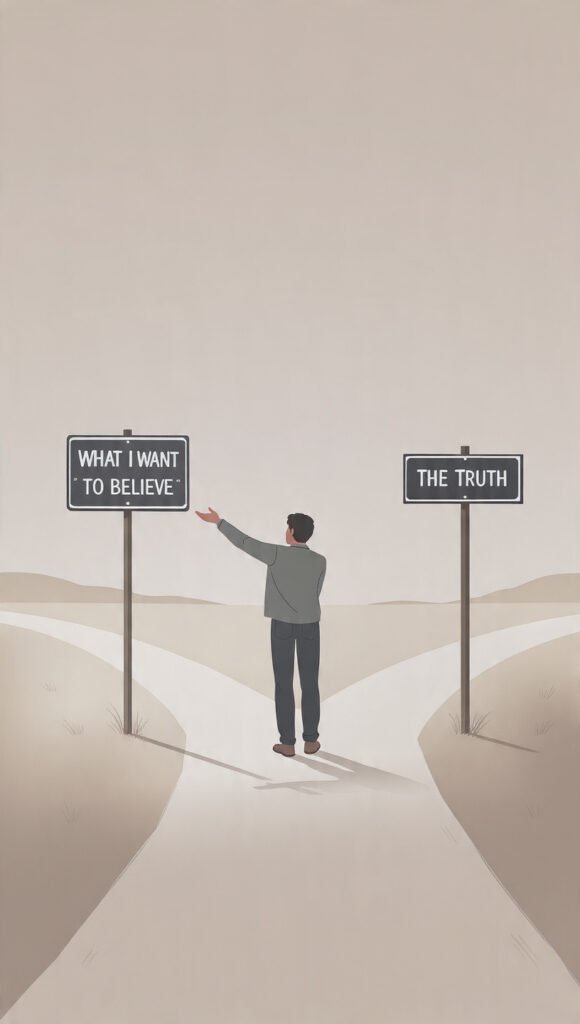
“You Remember the Hits but Forget the Misses”
This phrase perfectly describes confirmation bias.
A person who believes they are always unlucky will remember every unfortunate moment and forget every blessing.
A person who believes everyone is against them will notice every conflict but never the kindness.
A person who believes they are always right will remember every success in an argument but forget every mistake or false assumption.
We selectively replay the moments that confirm our internal story, and in doing so, we reinforce beliefs that may not even be true.
The Ostrich Effect: When We Hide from Discomforting Truth
Confirmation bias is often called the “ostrich effect.” Not because ostriches actually bury their heads in the sand, and they do not, but because the metaphor captures what we do mentally.
When information threatens our worldview or challenges our pride, our security, or our identity, we instinctively avoid it, deny it, minimize it, explain it away, rationalize around it.
We bury our heads to avoid the hard truth, because it feels safer to hide from contradiction than to confront it. But in reality, avoiding truth weakens us; it stops us from seeing accurately and growing deeply.
What is objective truth? What is subjective truth? My truth! Your truth! Our truth! Truth can only be objective! No! Truth can be objective! Truth can be subjective! For the most part, these were what I was hearing while I spent over 3 hours of my time watching a very interesting argument on YouTube yesterday.
Before you continue reading, what do you think? Is truth objective or subjective?
Well, that’s why you are here, and one truth I can tell you is that you are reading this article at this very moment; obviously. This boils back to the question whether truth is objective or subjective.
Continue Reading: What is Objective Truth: Is Truth Even Objective or Subjective?
Why Confirmation Bias is So Dangerous
It does not just distort your thinking; it sabotages your entire life.
It blocks personal growth: You can not improve if you avoid anything that challenges your weaknesses.
It fuels emotional immaturity: People who can not handle disconfirming truth often react with anger, defensiveness, or denial.
It destroys relationships: Confirmation bias makes you assume people’s motives, misread their actions, and stick to narratives that may be very very wrong.
It blinds you to opportunities: A closed mind can not see new paths, new solutions, or new possibilities.
It keeps you stuck in the same patterns: Because you only listen to what confirms you, you keep repeating the same choices and suffering the same outcomes.
Confirmation bias can seem comforting, but it is also very very crippling.
Your Mind Builds Echo Chambers
Most people assume echo chambers exist only on social media or political platforms. But the most dangerous echo chamber is the one inside your own mind.
- You repeat the same thoughts.
- You seek the same types of information.
- You surround yourself with people who think like you.
- You avoid environments that challenge you.
- You shut down perspectives that stretch you.
And over time, your mind becomes a loop, a closed circle of self-reinforcing beliefs.
To grow, you must step outside your own echo chamber.
The Heart Loves Agreement; the Mind Needs Correction
This is where maturity begins. Your heart wants comfort; your mind needs correction, and your growth requires confrontation.
The key to wisdom is not to seek agreement, but to seek truth.
Even if that truth is uncomfortable.
Even if it exposes your errors.
Even if it humbles you.
Even if it contradicts your assumptions.
Even if it forces you to change.
The goal is not to be proven right; the goal is to become wise.
So, I want you to ask yourself this question: do I want the comfort of a lie, or the deep, unshakable strength of truth? If I don’t stand for the truth, then what am I even standing on?
If you look for truth, you may find comfort in the end; if you look for comfort you will not get either comfort or truth, only soft soap and wishful thinking to begin, and in the end, despair. – C. S. Lewis
It is the quote by C.S Lewis that has been making me ponder since today, about truth and standing for truth. And in my head over and over and over again, I have broken this quote in segments and that is precisely what I want us to talk about today.
Continue Reading: Seeking And Facing The Truth Above All Else
How to Break Free from Confirmation Bias
Escaping this mental trap is possible, but it requires practice and humility.
Ask yourself: “What am I missing?” This single question can break the spell of one-sided thinking.
Look for evidence that challenges your conclusion. This is true intellectual honesty.
Do not argue to win; argue to understand. Seek clarity, not victory.
Surround yourself with people who disagree respectfully. Growth rarely happens in agreement; it happens in challenge.
Be willing to admit: “I might be wrong.” This is strength, not weakness.
Examine your emotional reactions. If information angers you, scares you, or makes you defensive, it may be because it challenges your identity and not because it is false.
Learn to love truth more than comfort. This is the foundation of mature thinking and spiritual growth.
One of the many things about the truth is that it has a way of demanding to be seen. It doesn’t care about our feelings, our fears, or how badly we wish something was different. But here is another thing I’ve also learnt, that when I chase, seek and stand for the truth, even when it’s uncomfortable, even when it shakes me up, that’s when I find real peace. The kind that actually lasts.
If you look for truth, you may find comfort in the end; if you look for comfort you will not get either comfort or truth, only soft soap and wishful thinking to begin, and in the end, despair. – C. S. Lewis
It is the quote by C.S Lewis that has been making me ponder since today, about truth and standing for truth. And in my head over and over and over again, I have broken this quote in segments and that is precisely what I want us to talk about today.
Continue Reading: Seeking And Facing The Truth Above All Else
Read Also: Truth Has Rules: The Basic Laws of Logic and Objective Thinking
Read Also: The Courage to Think: Why Truth Often Offends Before It Enlightens
Read Also: The Socratic Method of Thinking and Investigating: The Art of Questioning Your Way to Truth
Conclusion
Confirmation bias is comforting, because it protects your ego; it shields your pride, and it keeps you from discomfort. But it also keeps you from clarity, wisdom, and growth.
So my dearest readers, to see clearly, you must be willing to look beyond what confirms you. You must be willing to let truth and views challenge you; you must be willing to be wrong on your way to becoming right.
Because wisdom belongs to those who refuse to bury their head in the sand. Clarity belongs to those who confront the whole truth and not just the part that makes them feel good.
Grow beyond what confirms you! Look deeper than your assumptions! Seek truth, even when it stings! Because that is the path of maturity, freedom, and real understanding.