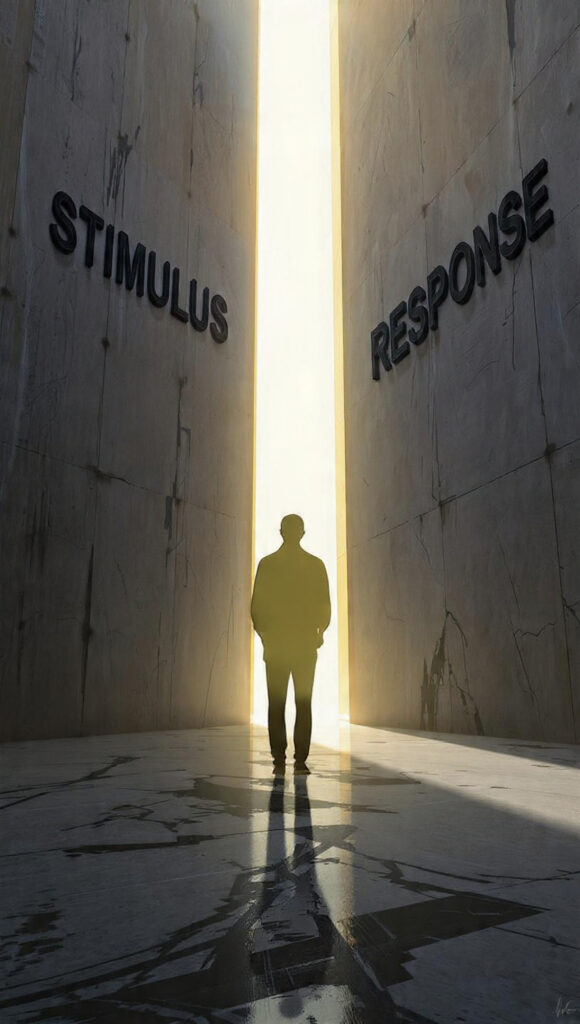
In the silent moments between a stimulus and your response, I would like to put it like this: a hidden world exists. And to the untrained mind, this gap is microscopic, and worse, it is nonexistent. The stimulus, an insult, a car crash, a sudden loss, happens, and the response is a scream, a flinch, a breakdown that follows instantly. But for those who seek self-mastery, this gap is a vast landscape that can be expanded, explored, and eventually colonized.
If we are to “master the space between,” we must understand why our brain favors the reflex and how we can train and systematically intervene to install a higher version of ourselves.
The Neurological “High Road” vs. “Low Road”
To change your reflexes, you must understand the hardware you are working with. In neurobiology, your brain processes information through two primary pathways: the Low Road (the Amygdala) and the High Road (the Prefrontal Cortex).
The Low Road: This is the fast-track. When a stimulus hits the thalamus, it sends a signal directly to the amygdala. This bypasses the thinking brain entirely, triggering an immediate emotional and physical reflex, and this is the source of the “unedited” character.
The High Road: Information travels from the thalamus to the sensory cortex and then to the prefrontal cortex, the seat of reason, ethics, and long-term planning. This path is slower but infinitely more sophisticated.
Mastery is the art of training the High Road to intervene before the Low Road can dictate your external behavior, and it is the process of making your “Choice” as fast as your “Habit.”
Expanding the Three Pillars: Deep Diagnostics
1. The Mental Reflex: The Narrative of the Unknown
When you encounter a “blank space,” a situation where you do not have all the facts, what is your reflexive narrative?
- The Paranoid Reflex: “They are out to get me; this is a setback.”
- The Stoic Reflex: “This is data; I must process it.”
- The Growth Reflex: “What is the opportunity hidden in this chaos?”
2. The Emotional Reflex: The Internal Weather
Observe your physical reaction to stress. Do your shoulders reflexively hunch? Does your heart rate spike into a “Red Zone” above 100 BPM, where cognitive function begins to drop? Mastering the emotional reflex requires Interoception; the ability to sense the internal state of your body. If you can not feel the reflex starting in your chest, you can not intercept it in your mind.
3. The Social Reflex: The Status Default
When someone challenges your authority or expertise, what is your reflex? Is it a “Diminishing Reflex,” trying to make them look small to keep yourself big, or a “Curiosity Reflex,” asking a question to understand their perspective? True character is revealed when your status is threatened. How do you react?
The Transformation: How to Rewire the Reflex
You can not think your way into a new reflex; you must act your way into it. Reflexes are built through “Long-Term Potentiation,” the strengthening of bonds based on recent patterns of activity. And how do you do that?
Step 1: The “Name to Tame” Technique
The moment you feel a reflex triggered, label it. “I am experiencing the reflex of anger.” Physiologically, the act of labeling an emotion moves the neural activity from the amygdala to the prefrontal cortex. You are effectively “turning on the lights” in the thinking brain.
Step 2: Implementation Intentions
Use the “If-Then” framework. Research shows that deciding your response before the stimulus occurs significantly increases your success rate.
- If I am interrupted in a meeting, then I will take one deep breath before speaking.
- If I feel the reflex to blame someone else, then I will ask myself, “What was my contribution to this outcome?”
Step 3: Progressive Desensitization
You do not train for a marathon by running 26 miles on day one. Just as you do not train your reflexes in a crisis. You train them in “low-stakes” environments. Practice patience in the mart-store line so that you have the reflexive muscle memory to stay calm when a million-dollar deal is on the line.
Why You Should Invest in Your Reflexes
In business, “Executive Presence” is most times a fancy term for refined reflexes.
A CEO who remains reflexive of “The Vision” while the company’s stock is plummeting inspires confidence not just because of their words, but because their composure is clearly not an act; it is an “X-ray” of their belief system. And as well, the same is true for a leader whose reflex is to “protect the ego” will eventually directly or indirectly chase their best talent, regardless of how many “servant leadership” books they quote.
In business, investors watch your reflexes during a “stress test” because they know that in a real market crash, you will not have time to consult your mission statement. You will act on your habits, and that again, my dearest readers, is why you should keep investing in the quality of your subconscious “code.”
Read Also: The Paradox Of Self-Awareness: The Observer And The Observed
Read Also: Stop Holding Contradictory Beliefs: A Lesson from Russell’s Paradox
Read Also: Kill Mediocrity: 5 Disciplines to Reclaim Your Productivity
Conclusion
We many times view our character as something static, a “personality” we were born with. But the truth is far more empowering: Your character is an architecture you are constantly building.
Every time you expand the space between impulse and action, you are adding a brick to that structure. Every time you choose a second reaction that is better and higher than your first, you are rewriting your biological destiny.
And so, the goal of life is not to reach a state where you never have “bad” impulses; the goal is to reach a state where your “good” reflexes are so well-trained that they step forward, uninvited, to represent you when you are most under pressure. Your first reaction is your history; your second reaction is your future. Master the space between them, and you master yourself.