So many of us love to treat governance like an afternoon talent show. We look at elections, political campaigns, and civic choices through the lens of entertainment, charm, and marketing appeal. We want our leaders to look good on a screen, tell us what we want to hear, and make us feel comfortable about the state of affairs. But ancient philosophy warns us that treating political leadership as a simple popularity contest carries a devastating cost.
More than two thousand years ago, Plato outlined a brilliant, biting political allegory in Book VI of The Republic that exposes the fundamental hazards of democracy and the limits of unchecked political popularity. It is known as the Ship of Fools, and its message is just as urgent today as it was in ancient Athens.
The Chaos on the Open Sea
To truly understand the gravity of this allegory, we have to first visualize the chaotic scene that Plato paints. Imagine a ship tossed in the middle of a dark, violent ocean as a massive storm pushes down upon it. The waves rise like walls around the vessel, the wind tears violently through the sails, and every movement of the ship threatens to send it further away from safety; plus, there is no clear shore. The sky is almost completely obscured by clouds, and the passengers have no idea whether the vessel is moving toward land, toward destruction, or simply in circles.
At the center of this chaos is the owner of the ship. He represents the public, the collective citizens. He possesses the vessel, and in some sense, possesses the authority to determine what happens to everyone aboard it. But there is a profound problem; although he owns the ship, he knows almost nothing about sailing it.
Plato describes him as physically powerful but somewhat deaf and short-sighted because he can not clearly hear what is happening around him, and he can not see far enough to understand the dangers ahead. In this context, his limitations are important because they represent a population that possesses political power without necessarily possessing the knowledge required to exercise that power wisely. The owner has authority, but authority and competence are not the same thing.
And this is where the allegory becomes uncomfortable. The sailors know that the ship owner has the ultimate power to determine who controls the vessel, so they begin competing among themselves for influence. But these sailors are not experienced navigators; they do not understand the stars, the currents, the winds, the seasons, or the geography of the sea. They have never properly learned the science of navigation. Nevertheless, they desperately want the helm.
And their argument is essentially that navigation is not a specialized discipline at all. Anyone can steer, they suggest. There is no need for genuine knowledge or preparation, so why should one person be considered more qualified than another? Why should someone have to study the sea before being trusted with the steering wheel? If someone can persuade enough people that he knows what he is doing, perhaps that should be sufficient.
And so the ship becomes a battlefield of competing personalities rather than a vessel guided by knowledge. The sailors shout over one another, and they fight for control of the helm. Each believes that he deserves the position, not necessarily because he knows where the ship should go, but because he believes he can convince the ship owner to give him the opportunity to steer it.
And because the ship owner can not properly distinguish genuine competence from persuasive performance, the sailors discover something incredibly dangerous: The easiest way to gain control is not to become a better navigator but to become better at manipulating the owner.
And so they begin flattering him. They tell him what he wants to hear; they appeal to his emotions, and they make promises. They entertain him; they give him wine, and they attempt to make themselves indispensable to him. Some may even attack or eliminate anyone who threatens their ambition. My dearest readers, the goal here is not to demonstrate that they understand navigation. The goal is simply to get the steering wheel.
The person who actually understands navigation becomes an inconvenience. Imagine the trained navigator standing quietly nearby. He has studied the sea; he understands the weather; he knows how to read the stars, and he can recognize dangerous currents and anticipate changes in the wind. He knows that steering a ship is not just a matter of grabbing a wheel and turning it in whatever direction feels right. But none of that necessarily makes him popular, because he can not compete with the sailors on their chosen battlefield because his expertise is technical rather than theatrical. He does not need to shout louder; he needs to know what he is doing. But in a contest where persuasion is valued above competence, the person with genuine knowledge can easily be drowned out by those who are more aggressive, charismatic, entertaining, or willing to tell the owner exactly what he wants to hear.
And this is the brilliance of Plato’s metaphor. The problem is not just simply that incompetent people are steering the ship. The deeper problem is that the entire system has become confused about what qualifies someone to steer in the first place.
The sailors believe that the ability to obtain the helm is evidence that they deserve the helm, but those are two completely different things. Winning control of something does not prove the ability to manage it. Being popular does not prove competence, being persuasive does not prove wisdom, and being confident does not prove knowledge.
And being able to defeat one’s opponents does not necessarily mean knowing how to guide everyone toward safety. The ship is therefore caught in a terrible contradiction, because everyone is intensely interested in who controls the helm, but almost nobody is seriously interested in whether the person holding it actually knows how to navigate. The passengers watch the struggle and perhaps even become emotionally invested in particular sailors. They cheer when their preferred candidate gains control; they boo when another takes over, and they argue about personalities, motives, promises, and victories. Meanwhile, the storm continues.
The ocean does not care who won the argument! The rocks do not move because the sailors gave a passionate speech! The wind does not change direction because someone received applause! Nature does not reward popularity! The ship still has to reach its destination!
And that is what makes the allegory so devastating. Reality eventually imposes consequences on incompetence, regardless of how persuasive incompetence may have been.
A sailor can convince the ship owner that he is the greatest navigator alive; he can gather supporters; he can silence his critics; he can make everyone feel confident about his leadership, but none of this changes the actual conditions of the sea. If he does not know how to navigate, the ship remains in danger.
Plato is therefore asking us to think beyond the personalities fighting over the helm. He is asking a much more fundamental question: What happens to a society when the ability to govern is separated from the knowledge required to govern well?
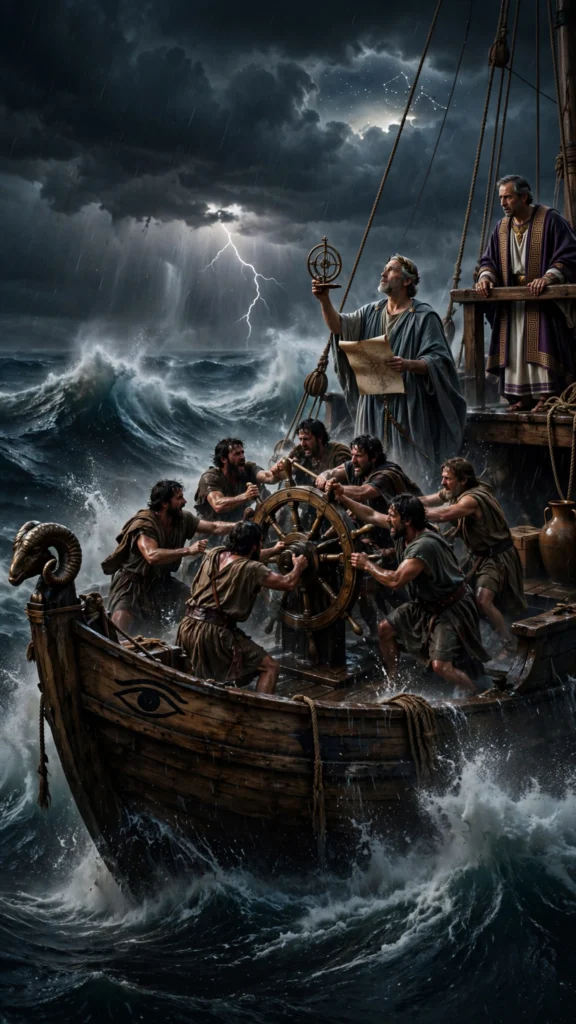
The ship becomes a floating theater of ambition, where every person wants the steering wheel, but few are concerned about what it takes and what the responsibility attached to it really means, and unfortunately, the helm becomes a prize rather than a burden. Leadership becomes something to possess rather than something to be qualified for.
And I think one of the most disturbing parts of the allegory is that the sailors are not necessarily pretending to be navigators because they genuinely believe navigation is easy. And the most disturbing part is that they may simply understand that the crowd does not know enough to recognize the difference between a navigator and an impostor, and that is where manipulation thrives.
If people can not distinguish knowledge from confidence, they become vulnerable to whoever sounds most certain. If they can not distinguish leadership from popularity, they may reward whoever entertains them most effectively. And if they can not distinguish competence from persuasion, the person who speaks most convincingly can eventually defeat the person who understands the problem.
The storm, meanwhile, grows stronger! The ship continues moving, and everyone aboard is forced to live with the consequences of whoever eventually captures the helm.
Plato’s image is not just about politics; it is about leadership itself. It is about the danger of confusing the desire to lead with the capacity to lead. It is about what happens when ambition becomes more important than competence, when popularity becomes more important than wisdom, and when the loudest person in the room is mistaken for the person most capable of navigating the storm. The ship does not need the sailor who wants the helm most desperately. It needs the person who knows where the ship needs to go and understands how to get it there.
The True Navigator Versus the Crowd
When the storm hits, the fatal flaw of this system becomes clearly obvious through the lens of two very different figures on board. On one side stands the true navigator: an actual trained expert who has spent a lifetime studying the stars, mapping tides, tracking weather patterns, understanding the mechanics of the vessel, and learning the unpredictable temperament of the sea.
The navigator does not need to shout to demonstrate competence; he does not need to entertain the passengers. He does not need to flatter the ship owner or promise that everything will be fine. His knowledge is demonstrated through his ability to read reality accurately, and that is precisely what makes him so uncomfortable.
The true navigator looks at the approaching storm and sees something the rest of the ship does not want to see. He sees the dark clouds gathering; he understands the direction of the wind. He knows that the current is pulling the vessel toward dangerous waters; he recognizes that the ship is carrying too much weight and that the voyages are improperly positioned. He knows that continuing along the current course is not just unwise; it could be fatal.
And so he tells the crew the truth: “Change course!” But the crew does not want to hear it. They have become accustomed to the comfort of the current direction. Maybe the navigator is telling them that they need to reduce their luxuries, repair the vessel, change their habits, or endure an uncomfortable journey before reaching safety. Or maybe he is telling them that some of the decisions they made earlier have consequences that can not simply be wished away, and none of this sounds particularly exciting.
The navigator can not offer them an easy solution because reality does not always contain easy solutions. He can not promise that everyone will get exactly what they want; he can not guarantee that nobody will have to sacrifice anything. He can not tell them that the storm is imaginary, and he can not change the laws of the sea simply because the passengers dislike them.
And because he refuses to flatter them, they begin to dislike him. The crowd starts calling him arrogant; they accuse him of being pessimistic. Someone says that he thinks he is better than everyone else, and another person mocks his obsession with maps and stars. Again, someone else asks why they should listen to a man who spends his time studying while everyone else is living. And just like that, the navigator’s competence itself becomes evidence against him. “He is too theoretical!” “He does not understand ordinary people!” “He has never lived our reality!” “He lacks charisma!” “He is too negative!” “He thinks he knows everything!”
And the irony is extraordinary. The very qualities that make the navigator qualified to steer the ship; his discipline, technical knowledge, willingness to confront uncomfortable realities, patience, restraint, and refusal to make promises he can not keep are interpreted as weaknesses in a culture that has learned to value entertainment over competence.
And so we see that even though it is evident that the crowd needs a navigator, they do not necessarily want a navigator. They want the reassurance; they want someone who will tell them that the storm is not serious, and they want someone who will promise that everything can remain exactly as it is while somehow producing a different outcome. And that, my dearest reader, creates the perfect environment for the rise of the incompetent pretender.
Plato uses this sharp contrast to argue that democracy constantly runs the risk of treating leadership like a superficial popularity contest rather than an essential craft requiring specialized skill, rigorous wisdom, and unwavering moral discipline.
The Rise of the Incompetent Pretender
And so, the person who ultimately wins control of the steering wheel is the loudest, most charismatic, and most entertaining person on board; he does not understand navigation, but he understands people.
He knows how to read the mood of the crowd; he knows which fears to exploit, which desires to amplify, which enemies to blame, and which promises will generate applause. He understands that the average passenger is not going to examine his technical qualifications; they are just going to judge him according to how he makes them feel.
So he gives them what they want; he hands out free wine; he tells them they deserve more; he tells them the storm is being exaggerated. He tells them that the navigator is simply trying to frighten them; he tells them that the ship can go anywhere they want because the people themselves should decide the direction, and the crowd applauds.
The pretender’s greatest weapon is not knowledge; it is confidence. He speaks with absolute certainty about things he has never studied. He turns complicated problems into simple slogans; he transforms legitimate criticism into personal attacks, and he tells the crowd that anyone questioning him is questioning them.
And before long, competence itself becomes suspicious.
The navigator says, “We need to change course.” The pretender says, “Why should we let one man tell us where to go?”
The navigator says, “The weather conditions have changed.” The pretender says, “He is trying to control you.”
The navigator says, “The ship is not capable of surviving this course.” The pretender says, “He does not believe in the people.”
And the crowd cheers. This, my dearest readers, is the political danger Plato is exposing. The incompetent ruler does not necessarily defeat the competent ruler by proving that he is wiser; he defeats him by changing the criteria by which leadership is judged.
And so, instead of asking, “Who understands navigation?” the crowd begins asking,
“Who do we like?” “Who makes us feel good?” “Who speaks confidently?” “Who promises us more?” “Who attacks the people we dislike?” “Who makes us feel understood?” And the question of competence disappears beneath the spectacle. And once that happens, leadership becomes theater. The pretender does not need to know where the ship is going; he only needs to convince everyone that he knows.
This is particularly dangerous because confidence is persuasive. A person who speaks hesitantly about something they understand can easily lose to a person who speaks confidently about something they do not understand.
But reality, however, does not reward confidence. The sea does not care how charismatic the captain is; the storm does not care how many people voted for him, and the rocks do not care how many followers he has. Reality eventually asks only one question: Can you steer the ship? That is the question that every leader eventually faces.
How Incompetent Rulers Sink the State
The consequences of this dynamic can be catastrophic for the state. Incompetent leaders rise to power precisely because they offer simple, soothing answers to complex, systemic problems. They tell the population that difficult problems have easy solutions; they promise prosperity without sacrifice, security without responsibility, freedom without discipline, and progress without cost, and they become experts at postponing reality.
When something goes wrong, they search for someone else to blame. The enemy is responsible; the previous administration is responsible. Foreign powers are responsible. The wealthy are responsible. The poor are responsible. The intellectuals are responsible. The opposition is responsible. Almost everyone becomes responsible except the person holding the steering wheel. And this is one of the most dangerous characteristics of incompetent leadership: the inability to distinguish between an explanation and an excuse.
A serious leader looks at a failing system and asks, “What are we doing wrong?” A pretender asks, “Who can we blame?”
A serious leader tells the population, “This will require sacrifice.” A pretender tells the population, “You deserve everything without sacrifice.”
A serious leader prepares people for reality. A pretender prepares reality to fit the story he has told the people. And for a while, the pretender may appear successful, and this is important to know, my dearest readers. Because incompetence does not always produce immediate disaster.
A badly governed ship can continue floating for a surprisingly long time. Favorable weather can conceal poor navigation. Previous generations may have built strong institutions that temporarily absorb the damage. A wealthy state may possess enough resources to compensate for bad decisions. A society may inherit infrastructure, knowledge, capital, and institutions that allow it to continue functioning even while its leadership deteriorates.
But accumulated incompetence eventually encounters reality, because the storm arrives. And when it does, there is nowhere left to hide, and this is when the difference between the navigator and the pretender becomes painfully obvious.
The pretender’s confidence can not calm the ocean; his slogans can not repair the vessel. His popularity can not change the direction of the wind; his ability to manipulate the crowd can not prevent the rocks from destroying the ship. And suddenly, the skills that seemed boring during peaceful times become indispensable.
Knowledge matters! Preparation matters! Discipline matters! Experience matters! Character matters! And the people discover, often too late, that they confused the ability to win the helm with the ability to steer the ship.
There is another dimension to Plato’s warning that deserves attention: The problem is not simply the existence of incompetent leaders. The problem is also the condition of the population that allows them to rise. A society can not continually reward manipulation and then act surprised when manipulation becomes its dominant political skill. If citizens reward politicians for saying whatever is emotionally satisfying, politicians will learn to say whatever is emotionally satisfying. If citizens punish leaders for telling uncomfortable truths, leaders will eventually learn to avoid uncomfortable truths. If citizens demand entertainment instead of competence, political figures will become entertainers. And if citizens care more about defeating an opponent than understanding a problem, politics will become a permanent battle between tribes.
The ship owner therefore can not escape responsibility just because he is not the one physically holding the wheel. He still decides whom to trust; he still decides whom to empower, and he still determines which qualities are rewarded. And this is precisely what makes Plato’s allegory more demanding than a simple warning about bad rulers; it is also a warning about the intellectual and moral responsibility of those who choose them.
The crowd must learn to distinguish between the person who tells them what they want to hear and the person who tells them what they need to hear. Because those are not always the same person; the leader who genuinely cares for the ship may sometimes have to disappoint the passengers. He may have to tell them that the vessel needs repairs; he may have to reduce their comfort; he may have to change direction; he may have to admit that the destination is farther away than they expected, and he may even have to tell them that some of their previous decisions were wrong. That kind of leadership is rarely intoxicating, but it may be necessary. The pretender offers comfort during the calm and confusion during the storm, but the navigator offers truth during the calm so that the ship can survive the storm, and that, my dearest readers, is the distinction that is everything.
Read Also: Eric Gugua Exposes the Flaw in Judging Credibility by Wealth
Read Also: Conviction: Living Honestly Even When Everyone Else is Cheating
Read Also: It Takes More Than Intelligence to Act Intelligently – Fyodor Dostoevsky
Conclusion
Plato’s Ship of State is a timeless warning about the dangers of confusing popularity with competence and charisma with wisdom. The central lesson is not that ordinary people are incapable of governing themselves. Nor is it simply an argument that experts should automatically possess political authority; no! A thousand times, no! The deeper warning is about the danger of allowing leadership to become detached from knowledge, character, competence, and responsibility. A ship can not be safely navigated by whoever happens to be the most entertaining person on board.
Likewise, a society can not afford to treat leadership as nothing more than a popularity contest, because the consequences of poor navigation eventually become unavoidable. For a while, the ship may survive; for a while, the crowd may celebrate; for a while, the pretender may look victorious, but eventually the storm comes, and when it does, reality becomes the final judge.
The question will no longer be who was the most popular, who received the loudest applause, who delivered the most memorable speech, or who had the largest following. The question will be much simpler: Did the person holding the wheel actually know how to steer?
This is where civic maturity begins; it begins when citizens learn to look beyond the spectacle. It begins when charisma is no longer mistaken for competence, confidence is no longer mistaken for wisdom, and popularity is no longer treated as proof of qualification. It means learning to appreciate the person willing to tell the truth even when the truth is uncomfortable.
It means respecting expertise without turning experts into unquestionable authorities; it means demanding character from those who seek power. It means understanding that leadership is not just the privilege of holding the wheel; it is the responsibility of knowing where the ship is going and having the courage to navigate it through the storm. And perhaps most importantly, it means recognizing that the fate of the ship does not depend exclusively on the person at the helm.