“Judas teaches one of Scripture’s most sobering truths. You can walk with Jesus and still never surrender to Him. He heard every sermon. He witnessed every miracle. He ministered with the twelve. Yet his heart remained untouched. Proximity to Jesus is not the same as intimacy with Jesus.” – Christian Edward-Ngwu.
I just saw that post by Christian Edward-Ngwu, and his observation is not just a historical footnote; it is a piercing indictment of the modern condition. I have said this over and over and over again in my previous articles, that we live in an era of unprecedented access to information. We can stream sermons from the world’s most gifted speakers, download digital Bibles to our pockets, and engage in theological debate at the tap of a button. But we must confront the uncomfortable reality that access is not the same as transformation, and hearing is not the same as obeying.
Judas Iscariot is the ultimate example of the person who stands in the light but never lets it penetrate the darkness of his own soul. His life serves as a warning that one can be physically close to the Truth while remaining spiritually miles away.
The Illusion of Religious Proximity
The Judas Posture as I have decided to call it is a state of being where we rely on our external surroundings to validate our internal standing. Judas was, by all accounts, an insider. He was chosen. He traveled the dusty roads of Galilee, he saw the lame walk, he heard the parables that would define human history, and he even participated in the power of the ministry itself. He had every advantage, and yet, he remained a stranger to the very heart of the mission.
This teaches us that proximity can provide a sense of security that is entirely false. We often mistake familiarity for loyalty. We assume that because we are in the “right” place, around the “right” people, and consuming the “right” content, our hearts must be in the right place, too.
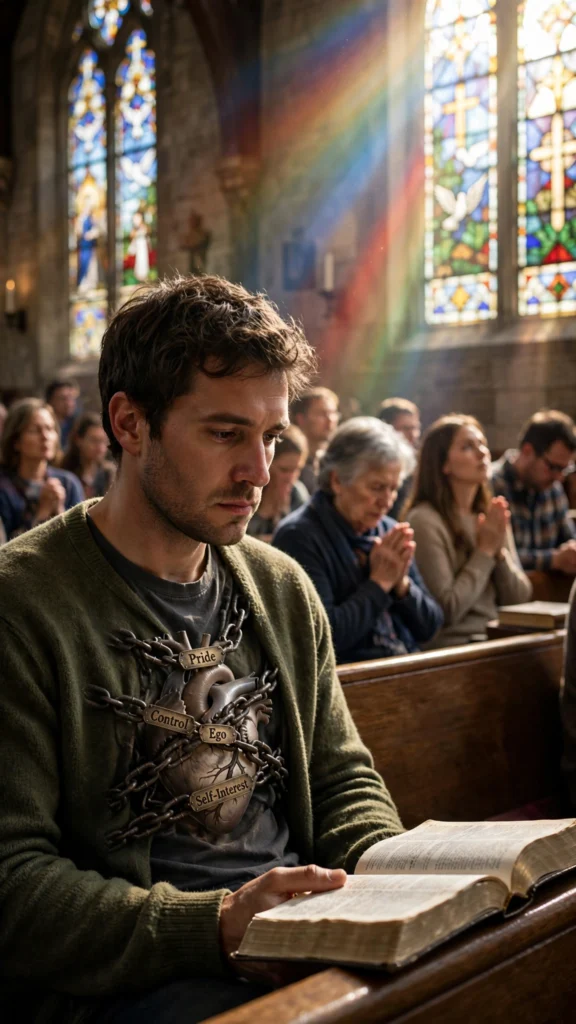
But the heart is a master of deception because it can play the part of a disciple while harboring the ambitions of a rival. As important as it is, when we rely only on our proximity to truth as proof of transformation, we allow our spiritual life to become a performance rather than a surrender. We get comfortable with the vocabulary of faith while our actual desires remain unbound from the spirit of that faith.
Now the question is why does someone who walks with the Truth remain unchanged? The answer lies in the posture of the heart. To surrender is to relinquish control, and that is a terrifying prospect for the ego. Judas was not just a passive observer; he was an active agent for his own ends. He sought to use his proximity to Jesus to facilitate his own agenda, whether that was political leverage, financial gain, or social standing.
My dearest readers, when our proximity to truth is used to serve our personal agenda, we inevitably harden our hearts. We start to treat the Truth as a tool for our own life-optimization, which in itself it not a bad, but even more, the Truth should be a mandate for our total surrender.
For so many of us, we listen to sermons to feel inspired, not to be convicted. We engage in ministry to feel significant, but not to serve with humility, and that exactly is the Judas Posture. The Judas Posture is characterized by this transactional relationship with the divine. We want the benefits of being near the source of power without the cost of being changed by it.
The Failure of Spectatorship
Judas was essentially a spectator of the divine. He saw the miracles, but he did not enter into the repentance that the miracles were meant to invoke. He listened to the parables, but he did not allow them to reshape his worldview. And this, my dearest readers, is the tragic fate of the spectator: You are close enough to witness everything, but you are not close enough to be gripped by anything, because of the posture of your heart.
My dearest readers, I ask you this just as I also ask myself: In our own lives, how often do we settle for being spectators? We view the pursuit of spiritual maturity as a spectator sport. But amazingly many of us admire those who have truly surrendered, we applaud their discipline, and we enjoy the fruit of their labor, and we stop, without actually committing enough to learn, grow and do the actual work. But definitely we want to be associated with the movement, but we do not want to be moved by the Spirit. My dearest readers, this distance is deceptive, because it feels like participation, but it is actually a form of isolation. By remaining spectators, we close ourselves off from the very thing that would break us, and in breaking us, remake us.
The opposite of the Judas Posture is radical surrender. If proximity is not enough, then what is? It is the total, unreserved commitment to being changed. It is the acknowledgement that my agenda, my logic, and my desires are secondary to the Truth I claim to follow.
And this is not a one-time decision; it is a daily, often backbreaking, posture of the will. Because radical surrender requires us to stop using Truth to manage our image and start using it to inspect our motives. I want you, my dearest readers, to pause, and let us read that again: Radical surrender requires us to stop using Truth to manage our image and start using it to inspect our motives. We must be able to step back and look at our own hearts. Why am I doing this? Is this motivated by a desire to serve, or by a desire to be seen? Am I truly listening, or am I waiting for my turn to speak? Am I surrendering my will, or am I just negotiating the terms of my obedience?
The Discipline of the Mind and Heart Posture
To be free of the Judas Posture, we must master the mind and heart posture. We must bring our internal processes into alignment with our external profession. This involves a rigorous, honest assessment of what drives our daily actions. Are we acting out of a place of genuine connection to the Truth, or out of a place of habit, social expectation, or self-interest?
This requires the point-blank pause, like I talked about in my previous article. We must intentionally create moments of solitude where we are forced to sit with our thoughts, where we can not hide behind the noise of our religious activities. And in that silence, the illusion of proximity vanishes, because we are left alone with the reality of our own hearts.
And we may find that, like Judas, we have been walking beside the Truth while our souls were headed in a completely different direction. My dearest readers, that realization is not meant to destroy us; it is meant to wake us up.
Another great question I am sure that you will have at exactly this time is how do we know if we are falling into the trap of the Judas Posture? And to that I say, the symptoms are often subtle but consistent:
The Loss of Wonder: When we have heard the truth for so long that it no longer moves us, we have become spectators.
The Desire for Control: When we try to manipulate our circumstances to guarantee a specific outcome, we are demonstrating a lack of trust in the one we claim to follow.
The Performance of Faith: When our external actions are for show, just to be seen and praised than we are living a divided life.
The Avoidance of Conviction: When we surround ourselves with teachers and systems that never challenge our comfort, we are avoiding the very thing that makes faith real.
These symptoms are not failures; they are red flags meant to guide us back to the center. They are invitations to stop the performance and start the surrender.
The reason so many choose proximity over intimacy is that proximity is just enough to feel safe, while intimacy is costly because it demand more from us. Proximity allows us to be in the room without letting the room change us, but intimacy, on the otherhand, strips away our defenses. It demands that we bring our brokenness, our failures, and our secret ambitions to the light. It demands that we be known, truly known by the one we follow.
Intimacy is the death of the ego. It is the point where we stop trying to impress and start trying to commune. It is the moment we realize that we have nothing to bring, and that is exactly what He is looking for, our hearts, empty and only to br filled by Him, for Christ to be Lord of our hearts. The transition from observer to follower is the transition from “what can I get” to “here is all I am.”
Practical Steps Toward Authentic Surrender
Another great question to ask at this moment my dearest readers, is how do we translate this high-level concept into daily life? It requires specific, practical action.
Audit Your Motives: Before you engage in any religious or service-based activity, pause and ask yourself, “Why am I doing this?” Be brutally honest with the answer.
Read for Conviction, Not for Content: Shift your focus! Instead of looking for information to add to your collection, look for the part of the text that strikes at your heart. Where are you being asked to change? And they way to do so is to open your heart, know that this truth of for the transformation of yourself before anything else, that way you do not become or remain a performer.
Practice Silence: You can not hear the whisper of conviction in a life that is constantly noisy. Carve out a time for silence that has no agenda other than to be present with the Truth.
Invite Accountability: We often think we know our own hearts, but we are frequently the most deceived. Invite someone, or a gathering, be committed to church and cell meetings, school, and again someone into your life who will tell you the truth, even when it hurts.
The tragedy of Judas is that he died clinging to the very things that kept him from the Truth, his money, his agenda, and his control. But the legacy of a changed heart is a life that is truly, deeply free. When you surrender, you lose the weight of managing your own performance. You lose the anxiety of needing to be in control, and you gain a freedom that proximity can never offer.
Maybe it is not you but for many the “Judas Posture” is a deeply rooted reality, but it is not a life sentence. We are all susceptible to the drift of religious habit. We all have the potential to stand in the light and remain in the dark. But every single day provides a new opportunity to turn our heads away from the crowd and our hearts toward the Truth.
Read Also: The Crowd is NOT Always Right: The Deceptive Effect of The Bandwagon Fallacy
Read Also: Revenge is a Lazy Form of Grief: Why Forgiveness is the Ultimate Act of Strength
Read Also: Build Confidence with Simple Daily Habits to Command Your Own Space
Conclusion
The question that echoes from the life of Judas is not, “How much have I done?” but, “Who have I become?” You can do a great deal of work and remain entirely untouched. You can be close to every religious resource imaginable and still have a heart that is closed off.
The Truth does not ask for just our proximity; it very very much also asks for our surrender. Do not be a spectator in your own spiritual life! Do not be satisfied with being “near” the Truth. Do not build your identity on the external markers of faith. Instead, pursue the terrifying, wonderful, life-altering experience of radical intimacy. Let the Truth break you! Let it reframe your narrative! Let it guide your daily actions!
Stay the course, keep auditing your own motives. You have the power to stop the performance, to silence the noise, and to fall on your knees in true, authentic surrender. That is the only path that leads to life. That is the only path that leads to the transformation you have been seeking, and that is the only path that truly matters.