Lately, for me and in this part of the world, I think we live in an era that I want to characterize by a paradox of loud voices and empty hands. Walk down any city street, scroll through any digital feed, or sit in any neighborhood coffee shop, and you will encounter a relentless wave of political critique. We have engineered a culture that is exceptionally skilled at identifying systemic failures, diagnosing bad leadership, and expressing fierce outrage at the state of our nation. We critique the economy, we evaluate the infrastructure, and we point fingers at the corruption or incompetence of the ruling party and class. We carry ourselves with the unshakeable posture of supreme political judges, fully convinced that our dissatisfaction gives us the moral authority to condemn the systems that govern us.
But beneath this layer of vocal outrage is a quiet, systemic rot of passive bystanderism, if there is any word like that, you know what I mean, being a bystander. Because when the time arrives for actual execution, millions of these same loud voices choose to stand down.
They find comfort in the shadows of non-participation. They retreat into political apathy, arguing that the system is too broken to fix, that their individual vote carries no weight, or that boycotting the process is a valid form of protest. They treat the electoral process as an optional consumer experience rather than a foundational human duty.
But this brings us face-to-face with a deep truth about personal accountability and human conduct. Few months ago, my friend Dike Blaise shared a powerful, heavy post that fundamentally shifted my focus.
Purpose demands your full tenacity. Give it anything less, and you forfeit the right to complain about the outcome.
Dike Blaise
Reading Dike’s post hit me hard; it forced me to look past raw, unstructured purpose and consider the weight of our shared civic responsibilities. His statement made me realize that this exact principle of execution applies perfectly to the way we treat our nations and our communities. If you withhold your energy, your effort, and your presence from a process, you have actively surrendered your moral right to dispute the final balance sheet. This profound realization sent me down a path of deep reflection, inspiring me to explore all the ways I can rephrase this core idea to address the massive crisis of political apathy we face today.
Today’s article might be a bit longer than usual, so please walk with me, and I want to rephrase and rephrase the quote over and over again. By utilizing the entire progression of these rephrased principles, we will dismantle the comfortable illusions of the passive observer, expose the logical contradiction of non-participation, and establish why a refusal to show up completely strips a person of their right to question the outcome.
The Forfeiture of Critique: The Immediate Cost of Non-Participation
The most seductive lie of the passive bystander is the belief that choosing not to vote is a clean, neutral act. The non-participant carries themselves as an untainted observer, looking down at the messy, imperfect political arena from a position of superior moral purity. They reason that by withholding their signature from the ballot, they remain entirely free from the blame of whatever disastrous leadership follows. They treat their absence as a shield that preserves their right to lunch uninterrupted criticism against the victors.
But this is a massive piece of broken causality and psychological evasion. In the real world of systemic structures, true neutrality does not exist. Every vacant space is an active choice that shifts the balance of power. While the compliant illusion makes us believe that staying away keeps us neutral and free from all blame, the unyielding truth is that our absence actively shifts power and fuels the political vacuum left behind. When you deliberately choose to withhold your presence from the arena, you are not stepping outside of the system; you are simply shifting the weight of your destiny onto the shoulders of those who do show up.
We must understand that democracy is not a spectator sport where your ticket guarantees you the right to boo or cheer from the safety of the stands. It is a collective, active enterprise of societal engineering. To believe that you can withhold your effort and still maintain a valid voice in the aftermath is a profound failure of basic accountability.
Democratic governance demands your full participation. Give it anything less, and you forfeit the right to complain about the political outcome.
Collins
When you step away from this foundational obligation, your subsequent complaints are completely empty. They carry no moral weight because you refused to provide the necessary counterweight when it actually mattered. The state of a nation is the direct reflection of the collective effort poured into its foundation. If the building collapses because you refused to help lay the bricks, you possess zero authority to criticize the quality of the shelter.
The Illusion of the Silent Protest: Surrendering the Democratic Voice
Many modern non-participants like to dress their apathy in the elegant clothing of a sophisticated “silent protest.” They claim that their absence at the polls is a profound statement of defiance against a flawed slate of candidates or a broken institutional framework. They argue that by refusing to participate, they are sending a powerful message to the political establishment that the current options are entirely unacceptable.
This is a beautiful, self-serving illusion designed to protect the ego from the heavy labour of real action. The political machinery of a nation does not possess an emotional conscience; it does not interpret empty voting booths as a sign of deep philosophical protest or intellectual sophistication. The system only reads numbers, presence, and concrete data points, and this creates a dangerous blank check trap where your silence directly relinquishes the arena, creating an unchecked vacuum that allows hostile or extreme factions to step in and take over.
By choosing to remain hidden in your home on election day, you are not resisting the system; you are actively abdicating your position as a guard at the gates of your country’s future.
The ballot demands your absolute presence. If you choose silence at the polls, you surrender your right to protest the leadership that follows.
Collins
If a hostile, incompetent, or highly corrupt leadership steps into the vacuum left by your absence, you have no right to express shock or outrage. Your silence was the very permission slip they required to take control. You can not hand over the keys to the kingdom through your inaction and then act angry when the new rulers drive the country straight into a ditch.
Progress Leaves a Physical Mark
True progress is never an abstract, spontaneous event that descends upon a society through wishful thinking or digital commentary. It is an organic, heavy structure built through concrete human action. Your internal virtues mean absolutely nothing until they are tested against the friction of an actual opponent. And in the civic arena, your political opinions and intellectual ideals are entirely useless until they leave a physical mark on reality.
The ballot box is the exact place where your internal philosophy transitions into a measurable external force. It is where your values cease to be just conversation topics and become actual legal directives. To believe that you can influence the direction of a culture while avoiding the physical arena of execution is a sign of extreme mental delusion.
Electoral progress requires your active footprint. Walk away from the booth, and you walk away from your right to criticize the direction of the nation.
Collins
When you refuse to leave your mark on the process, you effectively erase yourself from the story of your nation’s advancement. You become a ghost within your own society, a ghost that floats through the streets, consuming resources and enjoying protection, but refusing to contribute to the structural maintenance of the state. And so, if the landscape deteriorates around you, your criticisms are completely invalid. Because you can not refuse to march and then complain about the destination the army reaches.
Facing the Consequences of Inaction
One of the most foundational laws of life is that nature completely abhors a vacuum. If you leave a fertile piece of land untended, it will not remain beautifully clear; it will quickly be overrun by weeds, thorns, and invasive predators. And the exact same law governs the political landscape of a community. The spaces you leave vacant through your apathy will instantly be occupied by individuals who possess a highly aggressive appetite for power.
When you forfeit your vote, you are not stopping the wheel of governance. The wheel will continue to turn, laws will continue to be passed, budgets will continue to be allocated, and a ruling class will inevitably inherit the seats of authority. This exposes a clear division in how communities develop: while the responsible track relies on active presence, checked authority, and structured input to protect the future, the apathetic stand defaults to total absence, leaving behind an unchecked vacuum that breeds unchecked tyranny.
By removing your weight from the scales, you guarantee that the worst elements of society face zero resistance in their action.
Civic duty asks for your full engagement. Forfeit your vote, and you simultaneously forfeit your right to complain about the governance you inherit.
Collins
The leaders you end up with are the direct consequence of your choice to step aside. If their policies drain your resources, compromise your safety, and systematically dismantle your future, you must look directly into the mirror to find the primary accomplice. Your inaction was the silent engine that powered their victory.
The Direct Fight Against Social Decay
When we look at modern politics through the lens of media headlines, it is incredibly easy to fall into despair. We see endless division, systemic gridlock, and institutional failure. Our default brain looks at this messy narrative and whispers: “Why bother? It is a waste of energy to participate in a rigged game.”
But this is a major failure of critical thinking. High-value thinkers do not allow immediate emotional exhaustion to destroy their long-term execution strategy. They realize that social decay is an active, aggressive force that can only be pushed back through a matching level of internal tenacity.
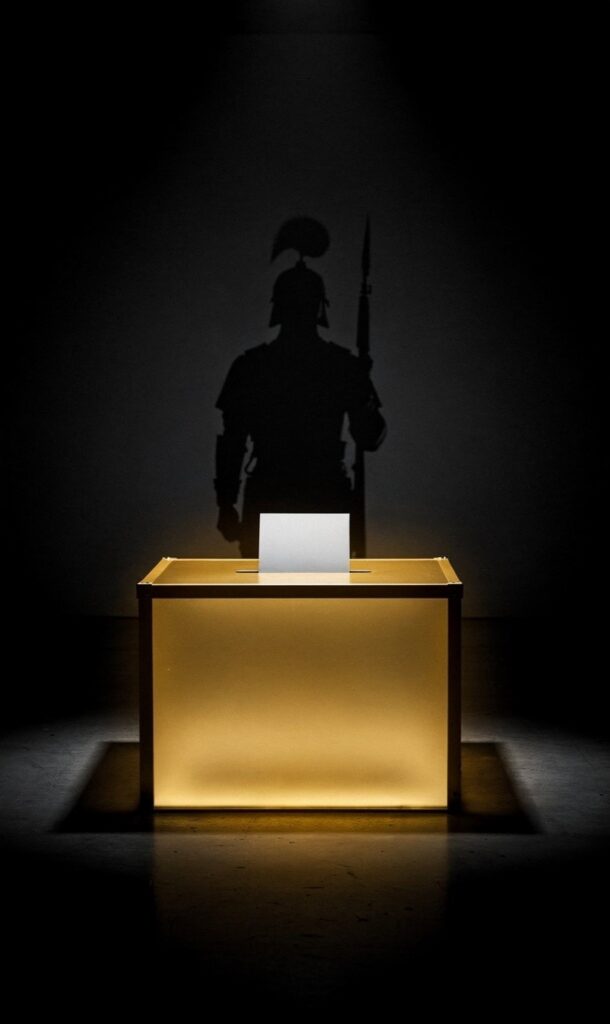
The future of governance demands your tenacity at the ballot box. Stepping back in apathy means forfeiting your right to question the outcome.
Collins
The moment you surrender your tenacity is the exact moment the dark forces of decay win by default. Participation is not about finding a perfect, flawless candidate who perfectly matches your every personal preference; it is about taking a firm stand to choose the most viable path forward and actively blocking the path of absolute destruction. It is an act of grit, determination, and unyielding character.
Blaming the Tools of Your Own Absence
When a nation faces an economic or social crisis, the favorite pastime of the non-participant is to place the entire blame on the political machinery itself. They point at the corruption of the electoral commissions, the bias of the media outlets, or the deep flaws of the constitution. They talk as if they are completely helpless victims of an external, hostile event that was forced upon them against their will.
But this explanation is a profound act of psychological avoidance. A democratic system is not an alien spaceship that landed from another galaxy to enslave us; it is a mirror that reflects the precise character, effort, and vigilance of the people or the corrupt. If the final script of your nation’s destiny is disastrously written, it is because you left the pen entirely in the hands of bad actors.
To sit out an election is to accept a future written entirely by others; you can not refuse to participate and then blame the ink.
Collins
If you allow your future to be written by the unchecked greed of special interest groups and the unchallenged ambition of some people because you were too tired, too cynical, or too sophisticated to show up, you have completely lost your right to complain about the storyline. The ink is completely blameless, and the fault also lies with the person who walked away from the desk.
Facing the Great Record of Civic Duty
When a true crisis hits, a high-value person does not look around for an external checklist or wait for someone else to save them. They perform an immediate, intense internal audit to ensure their own books are clean. The electoral process is nothing less than the great collective audit of a society’s shared character.
Imagine a major business where half of the shareholders refuse to show up for the annual meeting, refuse to look at the financial performance reports, and refuse to vote on the selection of the board of directors. If that corporation falls into bankruptcy three months later due to massive internal fraud, those absent shareholders hold absolutely zero right to launch a lawsuit against the organization. Their lack of supervision was the exact environment the fraud required to grow.
The electoral process is an audit of collective responsibility. If you do not show up to cast your account, you hold no right to audit the leadership later.
Collins
Every citizen carries a specific, non-negotiable account in the record of the state. When you refuse to show up and balance your account at the ballot box, you leave the entire system vulnerable to institutional corruption. If the books are cooked by corrupt politicians, your absence makes you an unindicted co-conspirator in the crime.
The Silent Endorsement: The Myth of the Neutral Bystander
One of the deepest cognitive errors we must delete from our internal mindware is the belief that inaction equals zero impact. In a dynamic, interconnected systemic structure, doing nothing is always an active choice that carries a heavy, real-world consequence. When you choose not to vote, you are not rendering your influence zero; you are simply distributing your power evenly among the factions that are actively participating.
If there are two major forces competing for the direction of a country, one that represents basic ethical standards and another that represents absolute chaos, and you choose to stay home because neither option is perfect, you have not remained neutral. While your intended internal statement might be that you are completely neutral, the cold external reality is that your inaction simply lowers the total win threshold required for the most corrupt faction to take complete control. Your apathy functions as an active, hidden acceleration tool for the worst possible outcome.
Apathy is the silent endorsement of whatever outcome occurs. If you give less than your full participation, you have given away your right to object.
Collins
You can not stand in the ruins of a destroyed economy or a fractured community and say, “Well, do not blame me, I did not vote for them.” You did not vote against them either. Your apathy was the exact cushion of comfort they relied upon to secure their position. You have given away your shield for the temporary comfort of an idle afternoon.
Choosing Silence When the Storm Arrives
Sovereignty is a word we love to use when discussing our personal freedom and national pride. We write anthems about it, we display flags to celebrate it, and we speak passionately about our independence. But true sovereignty is not a static piece of paper or a historical monument; it is a living, breathing muscle that must be continuously exerted through concrete action.
In the real world of geopolitical and social gravity, power belongs strictly to those who show up to claim it. The landscape of human history is not shaped by the wishes of the silent majority; it is carved out by the disciplined execution of the active minority.
Sovereignty belongs to those who show up. Choosing the sidelines means choosing silence when the consequences arrive.
Collins
When you choose the sidelines, you are willingly stepping down from your position as a sovereign creator of your environment. You transition into a passive subject who must helplessly absorb whatever economic storms, legal changes, and social restrictions the active participants decide to impose upon you. And when those consequences land heavily on your doorstep, your voice of protest means absolutely nothing. Because you chose the safety of the sidelines, and so, you must now endure the silence of the defeated.
Silence as an Enforceable Agreement
Every organized society functions on a deep, underlying unwritten social contract. By living within the borders of a country, using its infrastructure, enjoying its security, and participating in its markets, you are actively signing your name to that contract. You are agreeing to abide by its rules and contribute to its maintenance.
The ultimate expression of this contribution is your participation in the peaceful transfer of power through the ballot box. When you break this side of the contract by refusing to show up, you are effectively stating that you agree to accept whatever terms the remaining participants choose to draft on your behalf. Your silence is interpreted by the law of reality as total, unyielding compliance.
Silence at the polls is an agreement to whatever follows. Participate, or forfeit the right to complain.
Collins
You can not sign an agreement through your absence and then attempt to back out of its terms when the monthly bill arrives. If the taxes increase, if the infrastructure fails, and if the leadership devalues your currency, you have already legally agreed to that outcome through your choice to remain silent at the polling station.
Why the Table of Critique Requires a Ticket
There is a popular, fashionable sentiment among modern intellectuals that boycotting the system is a highly noble, principled stand. They talk as if their refusal to touch a flawed democratic process gives them a special, elevated seat at the table of political critique. They carry themselves like expert food critics who refuse to enter the kitchen but expect their reviews to be taken with absolute seriousness by the chef.
But in the arena of statecraft, this is a complete logical fallacy. The table of civic critique does not recognize the authority of those who refuse to contribute to the harvest. If you want a valid seat at the table where the future of your community is discussed, analyzed, and evaluated, you must first show your ticket of entry at the gate of execution.
You can not boycott the ballot box and then expect a seat at the table of critique.
Collins
If you refuse to buy a ticket, your opinions are nothing more than background noise. They are completely irrelevant to the actual builders of the structure. You have chosen to remove yourself from the ledger of stakeholders, and so, do not be surprised when the managers of the asset completely ignore your complaints about how the building is run.
In my deep dive into the Devil’s Advocate, I noted that an idea that can not survive an intense challenge from an opponent is entirely worthless. The exact same rule applies to your civic convictions. If your belief in justice, economic growth, and moral leadership can not survive the small exertion required to walk down to a polling booth and cast a vote, then your convictions are completely hollow. They are nothing more than a superficial fashion accessory designed to win validation from your social peers.
When you choose to withdraw your participation from an election, you are making a clear, conscious statement to the universe: “My comfort is far more important to me than the future of my country. My cynicism is more precious than my duty.”
The electoral process requires the full weight of your civic conviction. To withdraw your participation is to consciously waive your right to voice dissatisfaction with the regime.
Collins
You have executed a formal, conscious waiver of your democratic voice. If the resulting regime turns out to be an aggressive tyranny that actively dismantles your liberties, you can not raise your hand to object! You already signed the waiver! Your voice was voluntarily left behind in the dust of your own abdication!
Tyranny does not arrive in a society overnight through an unstoppable, supernatural force. It builds its power slowly, inch by inch, by carefully testing the boundaries of a population’s vigilance. Bad actors study the data reports of a nation; they look at the voter turnout metrics, and when they see a massive wave of political apathy, their eyes light up with immediate corporate joy. They realize that half of the population has voluntarily walked away from their guard posts.
An apathetic population is the ultimate ecosystem for corruption to flourish. It allows a ruthless, highly organized minority to secure absolute control over the state apparatus without ever needing to win the authentic consent of the governed.
True citizenship demands electoral tenacity. When we choose non-participation, we actively legitimize whatever leadership fills the vacuum.
Collins
Your choice to stay home is the exact tool they use to manufacture a false mandate. You have handed them the crown by default. By refusing to stand in their way at the ballot box, you have actively legitimized their climb to power, turning your own country into a shelter for unchecked greed.
The Logical Contradiction: The Self-Fueled Injustice
My dearest readers let us perform a cold, analytical mind check on the mental state of the non-participant. The non-participant stands in a long line at a government office, encounters massive institutional failure, watches their currency drop in value, and begins screaming into the void about how completely corrupt and incompetent the politicians are. They talk as if they are an innocent bystander who was struck down by a stray bullet of bad luck.
But if you ask this exact same person whether they showed up to vote in the last three cycles, they will shake their head with a cynical smile and say, “Of course not, voting changes nothing.” This is a massive, walking logical contradiction. Your mindware has completely crashed.
Complaining about bad leadership after refusing to vote is a logical contradiction; your non-participation is the very fuel that allowed the outcome.
Collins
You are actively complaining about the smoke while you are simultaneously holding the empty matchbox that started the fire. Your choice to pull your weight out of the system is the exact engine that allowed the incompetence to survive and scale. You did not avoid the crime; your apathy was the very oxygen that kept it alive.
Forfeiting the Audit: The Absolute Destruction of Authority
Throughout this entire article series, I have continually returned to the absolute necessity of the audit. A high-value life is built on a foundation of strict, unyielding metrics, and so, if you want to scale a business, you must audit the cash flow statement. If you want to build an authentic character, you must audit your daily conduct against real adversity. And if you want to maintain a functional society, you must audit the performance of your public servants.
And the ballot box is the ultimate, sovereign audit chamber of a free society. It is the exact place where you and your community enter the boardroom, reviews the performance charts of the ruling party, and executes a definitive directive to hire, fire, or re-calibrate the managers of the state.
The ballot is the ultimate auditor of our society. Forfeit your place in the audit, and you forfeit your authority to dispute the findings.
Collins
If you choose to boycott the audit chamber because you dislike the format of the meeting, you lose all standing to argue with the results of the investigation. If the remaining auditors approve a catastrophic strategy that leads to absolute ruin, your complaints are legally and morally dead. Because you walked away from the books; you must now accept the bankruptcy of your environment in absolute silence.
The Correct Standard: Presence Over Surrender
To move forward from this crisis of passivity and build a genuinely resilient, high-value culture, we must firmly reject the modern trend of sophisticated cynicism. We must stop treating political apathy as a sign of intellectual depth and see it for what it actually is: a soft, fearful surrender of personal accountability.
We must install a new, unyielding baseline standard within our personal development networks and community: absolute presence. We must show up for our civic duties with the exact same focus, discipline, and tenacity that we bring to our personal character audits and our career execution strategies.
We owe the democratic process our full, unyielding presence. Anything less is a quiet surrender of our right to demand better.
Collins
Stop waiting for a perfect candidate to descend from heaven before you decide to engage with reality. Real life requires you to step directly into the heat of the arena, evaluate the available options with an upgraded, rational mind system, and deploy your voice to shape the best possible path forward for your community. It is an act of deep character, moral vigilance, and absolute integrity.
Read Also: The Call to Engage: Why Good People Can’t Abandon a Broken System
Read Also: You Don’t Get to Be Apolitical: The Stoic Duty to Stand Up and Speak
Read Also: Upgrading Your Mindware: The Thinking Tools That Schools Forget to Teach
Conclusion
We can no longer hide behind the comfortable, lazy illusions of the sophisticated observer. We can no longer use our intelligence to construct beautiful, motivated narratives that justify why we walked away from our guard posts on election day.
True civic authority is fundamentally earned through concrete execution, physical presence, and real-world tenacity. It can not be won on a digital comment section, it can not be bought through empty consumer checklists, and it can never be maintained from the safety of the sidelines.
So my dearest readers, let us not allow the spirit of apathy to fire our soul right out of our citizenship. Let us not reduce our position as a sovereign creator of our nation’s destiny to a mere series of cynical data points. Let us choose to show up, plant our footprint firmly in the arena of execution, and guard our community against the decay. Let us build a life and community that stands firm, not just in raw critique and hollow outrage, but very, very importantly in active conduct, living truth, and absolute civic responsibility.