Do you know your bible? The Bible is not merely a collection of isolated stories or ancient moral codes; it is a grand, unified narrative of redemption. The journey from Genesis to Revelation is anchored by three transformative pillars: Covenant, Grace, and Justice. Together, these pillars reveal the heart of God, our Creator, who is relentlessly committed to His creation, abundant in mercy, and unwavering in His standard of righteousness. And so again, I ask: Do you know your bible?
The Unified Story of Scripture
From the opening “In the beginning” to the final “Amen,” the Bible presents the story of God’s persistent pursuit of humanity. While the Old and New Testaments are separated by centuries of history, they are bound together by a single divine intent. The Old Testament sets the stage, establishing the legal and relational foundations of the Covenant, the necessity of Justice, and the whispers of a coming Grace. The New Testament provides the fulfillment of these themes in the person of Jesus Christ, the “Messiah who has come.”
Understanding these three core messages is essential for grasping the message of the Bible and the heart of God. They provide the lens through which we can view the historical accounts, the prophetic warnings, and the apostolic letters as one cohesive work of divine authorship.
Covenant: The Relational Architecture of Faith
A covenant, in the biblical sense, is far more than a legal contract; it is a life-binding relationship initiated by God. It is the framework through which God says, “I will be your God, and you will be my people.”
1. The Genesis of Promise
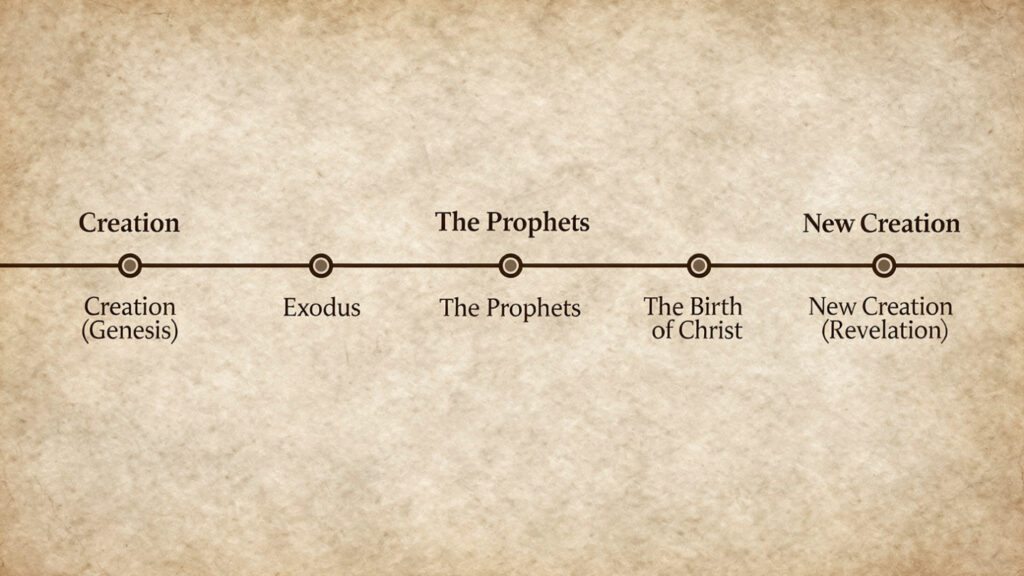
The narrative begins in Genesis, where “In the beginning God creates and calls.” Despite the fall of humanity, God immediately initiates a “promise that begins.” This is seen most clearly in the covenant with Abraham, where God pledges to bless all nations through his offspring, a promise that serves as the bedrock for the rest of the Bible.
2. The Exodus and the Law
In Exodus, the covenant moves from a family to a nation. God delivers His people “from bondage” through the sea, establishing a covenant at Mount Sinai. This agreement was not about earning God’s love but about responding to the love He had already shown through deliverance. The “holy people” were called to reflect the “holy, holy God” through the “Atonement” that brings them near.
3. The Davidic Hope and the New Covenant
Throughout the history of Israel, as recorded in Samuel, Kings, and Chronicles, God maintains His covenant despite human failure. In the “One Chronicle” of David’s line, the promise of an eternal kingdom is established. When Israel eventually stumbles, the prophets like Jeremiah speak of a “new covenant” that is “promised,” one that would be written on the hearts of men rather than on stone.
Grace: The Unexpected Gift of Redemption
If the Covenant is the structure of the relationship, Grace is the heartbeat that keeps it alive. Grace is the unmerited favor of God, appearing very, very clearly when humanity is most undeserving.
1. Grace in the Wilderness and Exile
Even in the book of Numbers, as the people wander “through deserts and doubt,” God’s “faithful pillar guides” them. Grace is found in the ruins; as Lamentations tells us, “Great is your faithfulness” even in the midst of sorrow. In the stories of Ruth and Esther, grace is shown as “loyal love” that “gathers the outcast” and preserves the people “for such a time as this.”
2. Grace Incarnate: The Gospels
The four Gospels, Matthew, Mark, Luke, and John, reveal that the “Messiah, King is come.” He is the “son of God” who comes to “serve, suffer, save.” This is the ultimate “good news for the lowly.” In Christ, we see “the word made flesh,” providing a grace that is both “faithful, pure, and strong.”
3. The Theology of Grace
In the books of Romans, Galatians, and Ephesians, the mechanics of grace are explained. We are “justified by faith,” finding “freedom in Christ.” This grace is our “armor,” protecting us and bringing us into “one family.” As 2 Corinthians reminds us, this grace is so powerful that “strength is perfected in weakness.”
Justice: The Standard of Divine Righteousness
The third pillar, Justice, ensures that the relationship is grounded in truth and righteousness. God’s justice is not just punitive; it is restorative, seeking to protect the vulnerable and correct the wayward.
1. The Prophetic Cry for Justice
The Old Testament prophets are the primary champions of justice. Amos famously cries out, “Let justice roll like mighty waters.” Micah summarizes the requirements of a faithful life: “Do justice, love mercy, walk humbly.” This justice is a call for the people to return to the heart of the Law, ensuring that their worship is reflected in how they treat their neighbor.
2. Wisdom and the Fear of the Lord
The books of Proverbs, Ecclesiastes, and Job provide the “wisdom’s path” that “begins with fear of the Lord.” True wisdom is recognizing God’s “sovereignty” even when “suffering” is present. And Justice, in this context, is living in alignment with the moral order God has established.
3. Justice as Service
In the New Testament, justice is translated into the “good deeds” and “sound doctrine” described in Titus and James. “Faith works” by “taming the tongue” and “caring for the weak.” It is a justice that transforms a “slave to brother in Christ,” as seen in Philemon.
Read Also: The Exclusive Claim: Is Jesus The Only Way to God?
Read Also: First the Spirit, Then the Mind: A Lesson from The Man of God, Pastor Chris Oyakhilome
Read Also: The Concept of Work: Why Christians Should Lead in Professional Excellence
Conclusion
The biblical narrative concludes in the book of Revelation, where these three pillars reach their peak. The “Lamb wins,” and a “new creation” is established “forever.” And in this final act, the Covenant is fully realized as God dwells with His people. His Grace is celebrated by the redeemed of every nation. His Justice is finally and fully established as all wrongs are made right.
Understanding this journey, from the “creates and calls” of Genesis to the “forever” of Revelation, allows us to see the Bible not as a mystery but as a roadmap for a life of purpose. It is a call to live within God’s covenant, to rely on His grace, and to pursue His justice in all that we do.