In today’s age of the “Alpha” influencer and the high-production-value podcast, a dangerous definition of masculinity and leadership has begun to take root. We are bombarded with clips of men arguing that to lead a home is to demand blind obedience, and that vulnerability and accountability are signs of weakness, and that the “provision” and “protection” the man brings is a transaction that buys a man the right to act without explanation.
But as the speaker, and like I mentioned in my previous article, one of my favorite speakers, Eric Gugua, pointed out in a recent, sharp critique of modern relationship dynamics, many are confusing leadership with control. One is a burden of service; the other is a thirst for power. One builds a sanctuary; the other builds a cage.
And so, we must perform a Character Audit on our understanding of authority. We must realize that true leadership does not need to shout to be recognized; it does not need to control to be felt, because true character is quiet, it is transparent, and very, very, very importantly, it is rooted in the strength of its example.
The Core Confusion: Power Over vs. Power For
The loudest voices in the, permit me to call it, the modern “manosphere,” the loudest voices often frame leadership as the exercise of power over another person. They argue that being the “head” of a home means having the final say without, let’s say, the inconvenience, or maybe the argument of being accountable to those they lead. But true leadership is the exercise of power for the benefit of others.
When a man argues that he does not “owe” his wife an explanation of where he is going, where he was, or what he is doing, what he was doing, he is not demonstrating leadership; he is demonstrating insecurity, or worse, he is being a bully. A leader who is afraid of accountability is a leader who is afraid of being seen. Control, especially the manipulative type, seeks to hide in the shadows of authority, while leadership thrives in the light of transparency.
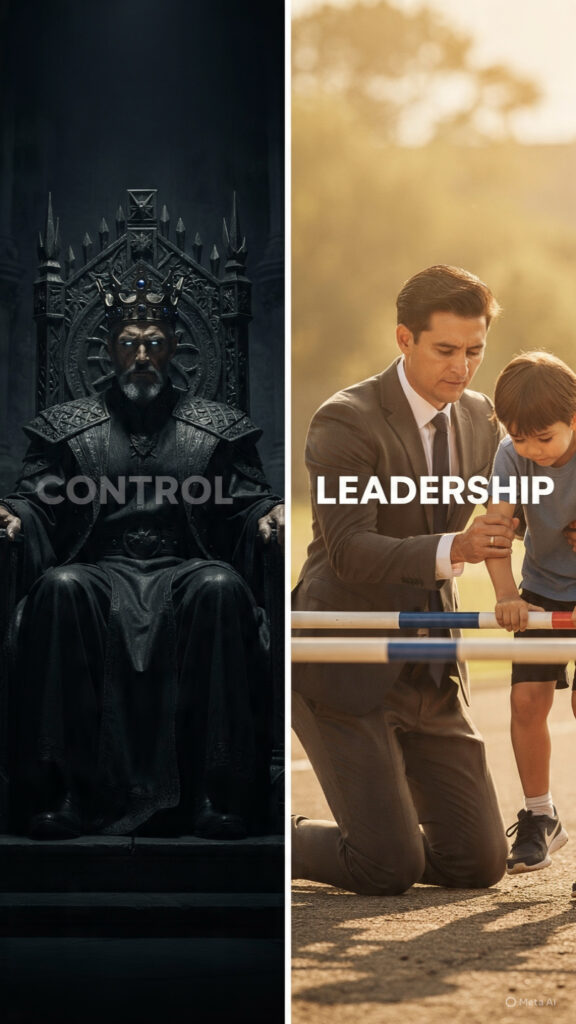
Leadership is a responsibility, not a rank. If you are the “Protector and Provider,” your primary job is to ensure that those under your care feel safe, not just physically, but emotionally and mentally. And it is very, very much likely that you can not provide security while practicing secrecy, at least not by example.
The Language of True Authority
Again, Eric Gugua points out that the essence of authentic leadership with a powerful observation by saying: If you have to shout, I am the leader, or I am your leader, in your own home; the chances are you not, or at least you are not acting as such, and he went further to add that “A leader no dey shout; people will know who is the head.”
So, take a minute to think of the most influential people you have ever met. Were they the ones shouting their titles from the rooftops? Or were they the ones whose presence commanded respect through their actions?
The “One-Eye” Rule
In a healthy environment, whether it is a home or a business, leadership is felt through a deep, mutual understanding. Gugua notes that a true leader can communicate everything necessary with a single look, especially in his home. This is not a look of fear or intimidation; it is a look of aligned values. Because as a man who is a leader, when you lead by example, your expectations are understood because you live them out every day.
Comfort and Support
The metric of a true leader is the comfort of the followers. If those you lead are constantly walking on eggshells, afraid to ask questions or seek clarity, you are not leading them; you are ruling them. True leadership creates an environment of support; it invites questions because it has nothing to hide, and it welcomes accountability because it knows that iron sharpens iron.
The Example as the Engine
You can not lead someone where you are not willing to go yourself. If you demand honesty but practice deceit, or demand respect but offer condescension, I put to you that your leadership is a fraud, you are a bully. True character means being the first to apologize, the first to sacrifice, and the most transparent person in the room.
The Danger of “Insane” Content
We live in a world where people can partner with insanity long enough to make it look like logic. And because of that, Eric Gugua, in that same video, warns that many modern conversations about relationships are designed to pander to the ego and lust of the audience. They tell men what they want to hear: that they can have all the privileges of leadership with none of the costs of character.
These “insane” arguments are particularly dangerous for the young and impressionable. When a young man sees a clip of someone “winning” an argument by being dismissive or dominant, he mistakes that aggression for strength.
But aggression is almost always a mask for a lack of internal substance. A man with a strong character does not need to win an argument, dominate a conversation, or a household to feel significant, because his significance comes from or ought to come from his integrity, not from the submission of others.
Stewardship and the Accountability of the Head
If you claim to be the “Head,” you are claiming the highest level of Stewardship. And in the context of leadership, the show of accountability is stewardship and is very, very important.
Being accountable to your partner is not about asking for permission; it is about updating, providing information and context, and sometimes, even before you are asked to do so. It is an act of love that says, “I value your peace of mind more than I value my ego.”
A man who refuses to be accountable is a man who is unfit for leadership. And why did I say this? Because accountability is the only thing that keeps power from turning into tyranny. If you are not accountable to the person closest to you, you are likely not accountable to your values, to God, or your future self.
Read Also: How to Build An Interdependent Relationship With Your Partner
Read Also: Coercive Control: Signs Your Partner is Trying to Control You And How to Get Out Of it
Read Also: Protect the Flame: The Accountability of a Life on Fire
Conclusion
The true character of leadership requires us to reject the cheap, loud version of dominion that is being sold to us today. We must return to the quiet, heavy work of building character.
A home should be a sanctuary, not a battlefield. And a relationship should be a partnership, not a hierarchy of silence or who has a voice. If you want to be a leader, stop looking for ways to exert your rights and start looking for ways to prove your trustworthiness by example.
Leadership is not about the crown you wear; it is about the floor you are willing to wash. It is not about the shouting; it is about the “one-eye” look that comes from a life lived with total integrity.
True character does not need to shout, because it is heard in the silence of its own consistency.