My dearest readers, I am sure you do not know this, but I studied Industrial and Applied Mathematics at the university. And lately I have been doing some reading, and I came up with an interesting idea of writing on several concepts in mathematics and how to relate them to the real world, and real-life self-development expression. And in today’s article, I want to look at the limit in Calculus.
When we are in school, we learn mathematics as a series of problems to be solved to reach a specific answer. We see a function, we apply a formula, and we arrive at a result. But as I have spent more time reflecting on these concepts outside the classroom, I have realized that the most important ideas in mathematics, specifically those in calculus, are not actually about the final destination. They are about the behavior of a system as it moves toward a point. They are about the nature of the journey.
The Concept of the Limit
In calculus, the limit is a way of describing what happens to a function as its input gets closer and closer to a certain value. The beauty of this idea is that the function does not actually have to reach that value for the limit to exist. You can move toward a point with infinite precision, getting closer every second, without ever needing to touch or occupy that specific point. I think in a very simple sentence, it is a mathematical way of describing a state of becoming rather than a state of being.
When we observe this movement in a mathematical sense, we see that the focus is on the behavior of the system during the approach. The destination is just a coordinate, but the limit is a description of the path taken to get there; it is the narrative of the journey itself. And I think that for o many of us we often try to live our lives in direct opposition to this mathematical reality. We obsess over the “result.” We view our lives as a series of checkpoints, like finishing this degree, getting that promotion, reaching a certain income level, or finally achieving a sense of balance. We treat these milestones as if they were the end of the function, the place where we finally stop and say, “I have arrived.” We operate under the delusion that once we cross a specific finish line, the struggle of becoming will cease, and we will finally settle into a permanent state of contentment.
But the problem with this way of thinking is that life is much like a mathematical function, which is dynamic. As soon as you arrive at one point, your input changes, and you are immediately drawn toward another. The moment you secure the promotion, you are faced with new responsibilities; the moment you earn the degree, you are confronted with the reality of the career path that follows. There is no terminal point in the human experience because growth is inherently continuous. And so by chasing a static “end,” we fight against the very nature of existence. What I mean is this: however high you feel you have gotten in life, there is still a lot of growth to be made, and growing this way should be our mentality.
True wisdom lies in recognizing that our lives are defined by the limit, meaning there should always be a higher point to aim at, a higher trajectory we carve out as we move toward our ideals. When we shift our focus from the final destination to the act of approaching, we stop viewing our lives as a series of disconnected boxes to be checked. And we begin to see ourselves as systems in constant development. We realize that the value of the effort is not in the acquisition of a final state, but in the refinement of our character during the approach. We start to understand that “arrival” is a myth, while the process of becoming, the continuous adjustment, the learning, and the refinement is the only reality that actually shapes who we are. Embracing this mathematical truth allows us to release the anxiety of the destination and find purpose in the momentum of our daily lives.
Moving Toward the Wall
Think of the limit as the experience of walking toward a wall. If you stop one millimeter away from that wall, you have not technically touched the surface, but you have reached a position that defines your proximity. You know exactly where you are. You know the distance you have traveled. You know the speed at which you are approaching. If you had kept going, you would have crashed. And just like that, the limit tells you everything you need to know about your current state of motion without requiring you to actually hit the barrier.
And so, my dearest readers, in our personal growth, we often define our success by hitting the wall. We want to touch it. We want the finality of “being done.” We want to look at our lives and feel that we have checked off all the boxes, assuming that the impact with the wall signifies a job well done. But when we prioritize the arrival, we miss the precision of the approach. When we are so focused on the destination, we stop paying attention to the way we are moving. We stop learning from the trajectory, from the journey, and from experiences. We stop adjusting our velocity. We lose the ability to see that the process of “approaching” is actually where all the growth occurs.
In my heart, this is not a typical example, but it is what I can think of at the moment, so consider the athlete who becomes so obsessed with the podium that they lose their love for the training. They are no longer focused on the mechanics of their movement, the alignment of their body, or the steady, incremental gains in their performance. They are only focused on the moment of contact with the goal. In that blindness, they will miss the very signals that would allow them to optimize their performance. They will crash into their own expectations because they failed to read the proximity of their reality. They were so intent on the result that they ignored the necessity of adjusting their pace, their methods, and their mindset along the way.
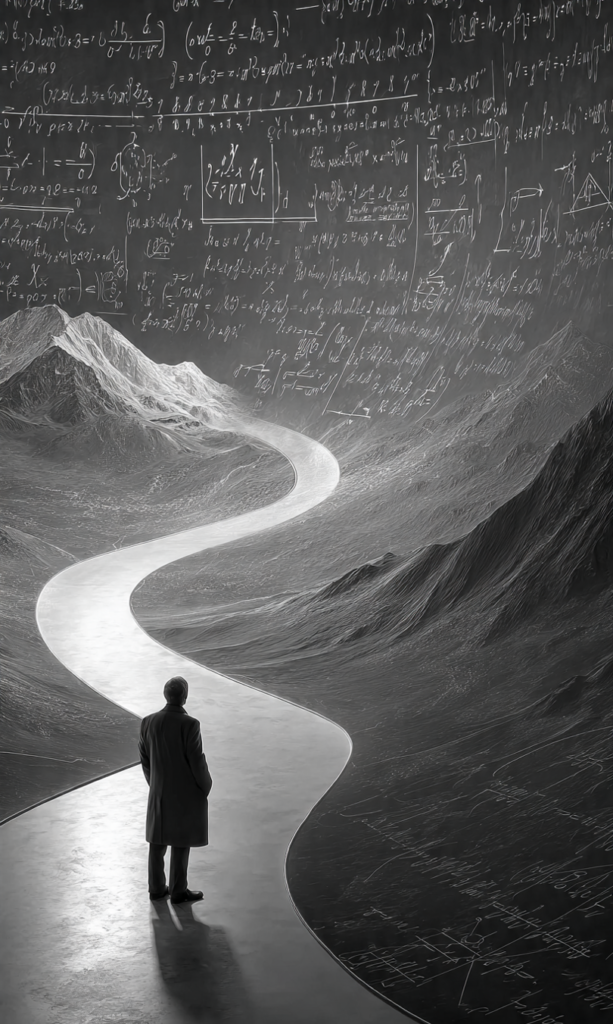
And this is the danger of just a goal-oriented life that lacks the awareness of the limit. We assume that if we are not “there,” we are failing. We feel that distance from the goal is a sign of lack, rather than a sign of progress. But if we adopt the perspective of the limit, that distance becomes a laboratory for our development. Every millimeter we cover is an opportunity to analyze our speed, our direction, and our control. We stop viewing the distance as a gap to be closed as quickly as possible and start viewing it as the space where our character is formed.
My dearest readers, trust me when I say that by valuing the precision of the approach, we take control of the variables that actually matter. As important as it is, we stop asking “How soon can I get there?” and start asking “How am I moving while I am here?” We realize that the intensity of our effort and the intentionality of our habits are what define our existence. And with that, the goal remains a beacon, but the true work, the true life, and the true development happen in the space before the wall. When we finally reach the limit of our potential, we find that the wall was never the point; the point was the discipline, the clarity, and the growth we gained in the act of moving toward it.
The Limit: Redefining Perfection
If we take the limit as our guide, perfection changes its meaning. It is no longer a static point we are trying to land on, but instead, it becomes a direction. It is a limit we are perpetually approaching. You will never be “perfect,” just as a function often never actually reaches its limit value in the way we expect. But you can be consistently, intentionally, and relentlessly moving toward a standard of excellence.
And this is the essence of the “Do Better, Be Better” mindset. It acknowledges that the work of improving is never finished. There is no day when you can sit back and say you have maximized every potential in your life, I think, but every day, you can get closer. You can close the gap by another millimeter. You can refine your approach, and you can analyze your behavior as the input changes. By shifting our focus from the final destination to the limit we are approaching, we take the pressure off the need for instant arrival and place it on the quality of our daily movement.
My background in industrial and applied mathematics taught me that systems are rarely static. They respond to variables; they shift based on conditions, and your life is exactly the same. You are not a fixed point on a graph; you are a function that changes as your circumstances, your choices, and your wisdom evolve. But when we treat life as a static achievement, we become rigid. We stop responding to reality because we are too focused on a plan we made a long time ago.
But when you accept that life is a function, you gain a sense of freedom. You realize that you can evaluate your progress at any given moment. You do not have to wait for the end of the year or the end of a project to see how you are doing. You can look at your behavior right now and see the direction you are heading. You can calculate your current velocity. You can see if you are approaching a point of growth or if you are moving toward a barrier that you do not actually want to hit.
The Discipline of the Approach
There is a deep level of discipline required to focus on the journey rather than the arrival. It is easy to be motivated when you have a finish line in sight. But it is much harder to maintain that same level of focus when you understand that the finish line keeps moving. This is where the beauty of the limit really shines, because it teaches us that our significance is not found in the final result, but in the consistency of our approach.
My dearest readers, take a minute to think about the daily habits that build a life. Whether it is reading, consistent professional development, or the way you treat the people around you, these are the components of your function. They are the inputs, and the output of your life is determined by how you manage these inputs day after day. You do not build a life by touching one big wall of achievement; you build a life by managing your path as you approach your highest potential. And so, we have to be willing to look at the process and refine it. We have to be willing to adjust our course as we get closer to the things that matter most.
When you finally reach a goal, the joy is often shorter than you expected. You celebrate for a moment, and then you are looking for the next thing. That is because humans are wired for growth, not for stagnation. We were meant to keep moving, to keep learning, and to keep expanding our limits. If you make the arrival the main event, you are setting yourself up for disappointment over and over again.
But if you make the journey the main event, you are likely never disappointed. You are always in the process of becoming. You are always engaging with your current reality and refining your movement. You are living in a state of intellectual and spiritual sobriety, fully aware of where you are and where you are headed. You are not worried about hitting the wall because you know that the wall is just a construct. The real reality is the distance you have covered and the person you have become while covering it.
By all means, it is okay to have goals; in fact, it is great. It is okay to look toward the wall and see where you want to be, but do not let your desire to reach it blind you to the reality of the approach. When you find yourself getting closer and closer to your goals, do not rush the process just to say you have made it. Enjoy the proximity! Enjoy the growth! Enjoy the refinement that happens when you are right on the edge of a new level of achievement.
I find that when I look at my own life through this lens, I am much more patient with myself. I do not feel the need to force results before they are ready, and I did not learn this out of the nobility of learning, I learnt because I have made heavy mistakes that I can not begin to get into. I understand that my current position is a necessary step in the movement of the whole. I am a function with a specific trajectory, and as long as that trajectory is pointing toward the standards I value, I am successful. I am moving. I am growing. I am approaching.
Read Also: Newton’s First Law for Personal Growth: Start Moving, Stay Moving
Read Also: The Neuroplasticity Blueprint: A 30-Day Manual for Rewiring Your Life
Read Also: The Guarded Mind: Why Your Entertainment Choices Matter
Conclusion
So, going forward with my next couple of articles, I want to show that Calculus provides us with the tools to understand the world, but it also provides us with the metaphors to understand ourselves. By embracing the concept of the limit, we choose to prioritize the journey over the destination. We accept that life is a continuous function, and that our greatest potential is found in the way we approach our goals, not in the moment we finally land on them.
My dearest readers, as you move forward in your own lives, I encourage you to be intentional about your trajectory. Watch your movement, refine your inputs, and keep your focus on the quality of your approach. Remember that you are building something that is meant to last, and the only way to do that is to ensure that your path is consistent, deliberate, and forever moving toward the person you were created to be. Stay the course, keep approaching, and keep doing better and being better.