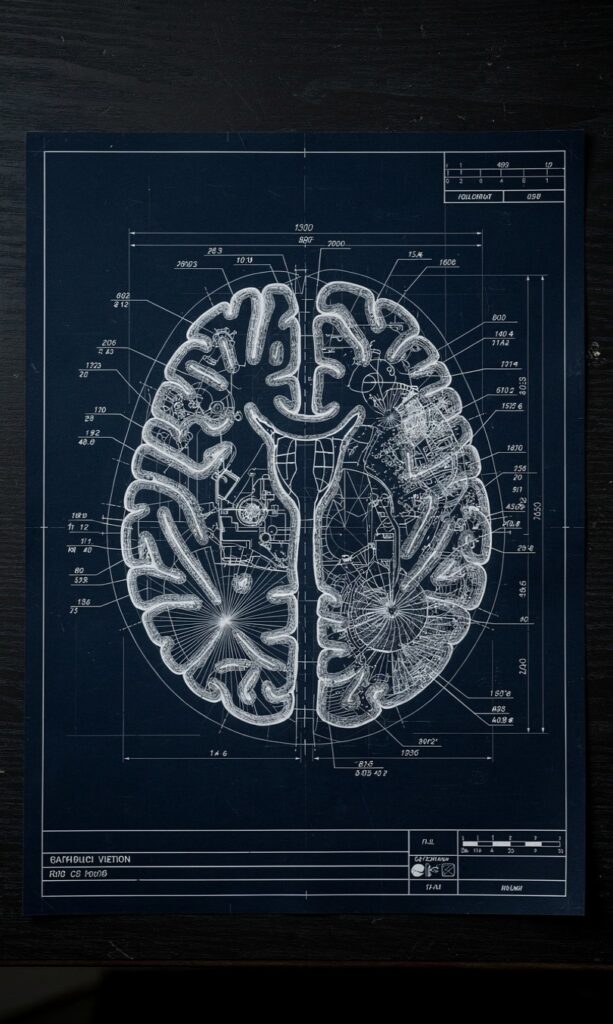
The human brain is not a static monument as I talked about in my last article; it is a living, breathing laboratory. We have spent lifetimes operating on the assumption that our personality, our attention span, and our character are fixed; that we are simply “built this way.” But the reality of neuroplasticity suggests something far more dynamic.
You are not a finished project. You are an ongoing architectural endeavor, and every action you take is either a structural reinforcement of your current state or the beginning of a new foundation.
And if you are tired of the autopilot life, where you react to stress with familiar irritation or succumb to distraction despite your best intentions, it is time to stop waiting for change to happen to you. Now is the time to start engineering it. And so this blueprint is your 30-day manual for taking command of your neurological architecture, replacing the weak, accidental pathways of your past with the high-speed roads of purpose, integrity, and focused excellence.
The Philosophy of the Brain-Gym
To rewire your life, you must first accept the foundational premise of neuroplasticity: your brain optimizes for what you repeat. If you spend your days consuming bite-sized content, your brain will optimize for fragmented, shallow attention. And if you react to every social media notification as if it were a life-or-death priority, your brain will optimize for high anxiety.
You are essentially training your nervous system for the reality you currently inhabit.
And so changing this requires more than positive thinking; it requires deliberate cognitive resistance. You must force the brain to abandon its preferred, easy pathways and follow the unpaved, difficult ones. And this is why change feels like resistance. That initial struggle, the mental fatigue, the urge to return to old habits, the feeling that your brain is “fighting” you is not a sign of failure. It is the sensation of progress. It is the physiological soreness that precedes true growth.
For the sake of steps and order for this article, while this 30-day blueprint provides the structure to jumpstart your transformation, my dearest readers, you must understand that the true work of neuroplasticity is not confined to a single month. I say that to say: This is not a temporary project; it is the permanent discipline of your existence. And every phase outlined here must become your perpetual practice, carried out with relentless consistency in every passing hour, every minute, and every single second of your life.
Phase 1: The Environmental Audit (Days 1-7)
You can not build a new mind in an old environment. If your surroundings are saturated with the noise, drama, and instant gratification that reinforced your old neural pathways, your efforts to change will be strangled. So many people approach self-improvement by trying to “willpower” their way to better habits, but only to find themselves constantly pulled back by the gravity of their current environment. This phase, the environmental audit is about changing the gravity, not just the intent.
The Protocol
Input Fasting: Eliminating Mental “Junk Calories”
For seven days, you must perform a radical inventory of your mental intake. We too often than not consume information with the same lack of awareness that one might have while mindless snacking, scrolling through social media feeds, keeping the TV on as background noise, or engaging in conversations that thrive on gossip and negativity.
This “mental junk food” creates high-dopamine, low-value neural spikes that keep your brain trapped in a state of reactive fragmentation. My dearest readers, during these seven days, we will treat our minds as a high-performance system: if an input does not serve your cognitive or character objectives, it is purged.
And this means zero tolerance for those junky headlines and the endless, algorithm-driven feeds that are designed to capture our attention at the expense of our clarity.
The Gatekeeper Protocol: Radical Discernment
You are the architect, the resident, and the guard at the gate of your own mind. Most of the information we consume, we consume by default, letting any idea, fear, or opinion walk through our front door. The Gatekeeper Protocol demands that we stop acting as passive recipients.
Every piece of information, whether it is a news alert, a conversation with a colleague, or a video recommendation, must pass a simple, binary test: Does this reinforce the person I am becoming, or the person I am trying to leave behind?
If an input does not bridge the gap toward your desired character and cognitive capacity, it should be denied entry. And this protocol builds the neural “stop-switch” that will eventually allow us to ignore distractions before they even reach our conscious awareness.
Space Creation: The Silence
The most overlooked tool in neurological hygiene is silence. In our modern age, we have an irrational fear of the void; we believe that if we are not being stimulated, we are being unproductive. But in reality, the brain’s most critical “housekeeping” happens when the inputs stop.
Silence is the incubator for the brain’s “pruning” mechanism. When you remove the constant noise of the world, you stop the firehose of information that demands constant, shallow processing. This allows the brain to finally address the overgrown, useless neural pathways that have been cluttering your cognitive space.
My dearest readers, practicing silence is not about doing nothing; it is about providing the brain with the necessary time to clear the trash of old habits. By carving out this space, you are not just relaxing; you are systematically dismantling the architecture of your past, preparing the ground for the high-impact growth that follows in the coming weeks.
Phase 2: Cognitive Resistance Training (Days 8-14)
Once you have successfully cleared the cognitive clutter during your first week, you move from the defensive posture of auditing your environment to the offensive posture of building your capacity. And this phase is designed to “stress-test” your brain, forcing it to adapt to higher demands of focus and endurance. This is where we move from removing the bad to actively constructing the infrastructure of excellence.
The Protocol
The 15-Minute Sprint: Forging the Focus-Muscle
In a world designed to fracture your attention, maintaining sustained focus is an act of rebellion. Every day, dedicate 15 minutes, strictly timed, to a task that requires absolute, uninterrupted mental engagement. This is not the time for checking emails or responding to pings; it is for deep-work activities like complex analytical reading, original writing, or mastering a difficult technical concept.
The rule is absolute: if your mind wanders, acknowledge the distraction without judgment and gently steer it back. You are not allowed to reach for your phone, switch browser tabs, or “multitask.” Because by forcing your brain to remain on a single, challenging track for 15 minutes, you are effectively “re-paving” the pathways that allow for deep, sustained cognition, which have likely been eroded by years of shallow, fragmented consumption.
The Discomfort Drill: Training Presence
We are conditioned to treat every mundane moment as a waiting room for the next digital dopamine hit. We listen to podcasts while we walk, scroll through feeds while we eat, and check notifications while we wash dishes. This constant multitasking prevents you from ever being fully present, training your brain to perpetually seek “more” stimulation.
But the Discomfort Drill breaks this cycle by forcing you to be bored. So my dearest readers, choose one mundane activity like washing dishes, walking to the store, or even sitting in a waiting room, and perform it with total, rich presence. Notice the temperature of the water, the texture of the surfaces, or the specific flow of your surroundings. And mind you, this is not meditation in a traditional sense; it is “Presence Training.” You are teaching your brain to derive satisfaction and clarity from the immediate, physical world, which drastically reduces your susceptibility to the constant call of digital distractions.
The Resistance Test
When you engage in the 15-Minute Sprint or the Discomfort Drill, there will come a moment, usually right around the 10-minute mark, when your brain will send out a “neural alarm.” You will feel a sudden, itching urge to quit, to check your phone, or to switch to an easier, more stimulating task. Most people interpret this as a signal that they are “tired” or “done.”
But in this phase, you must reframe that alarm. Recognize it for what it is: the brain’s primitive, defensive reaction to the discomfort of growth. When you feel that urge, pause, take a breath, and deliberately stay in the task for just two minutes past the point of resistance. Those two minutes are the most important part of your training, because by overriding the alarm and persisting, you are physically forcing your brain to move past the “hardwired” limitations of your old habits.
You are, quite literally, paving a new, high-speed neural highway for persistence and executive function. You are proving to your nervous system that you are the master of your own focus, not a slave to your impulses.
Phase 3: Cross-Training (Days 15-21)
By the third week, you have cleared the trash of your old environment and begun to forge the capacity for deep focus. But the human brain is an efficiency-seeking machine; left to its own devices, it will quickly turn your new “deep work” habits into yet another automated routine. And so, to prevent your cognitive growth from hitting a wall, you must engage in neuro-cross-training. Just as an athlete prevents muscle decline by varying their routine, you must force your brain to activate underutilized regions and communicate through new channels.
The Protocol
The Non-Dominant Shift
We spend most of our lives operating with a “preferred” side, essentially allowing half of our motor system or part to dominate our daily experience. Performing simple tasks, like brushing your teeth, clicking a mouse, or opening doors, with your non-dominant hand might feel awkward, but that friction is exactly the point.
This shift forces the brain to move beyond its established motor maps and facilitates communication across the other parts and every system, like the bridge connecting your left and right hemispheres of your brain. By demanding that your brain coordinate these movements using an unpracticed hand, you are literally forcing it to recruit new neural pathways and reorganize its coordination. And I read a lot that this trivial-feeling exercise is, in fact, a high-intensity workout for neural plasticity.
Breaking the Autopilot Stagnation
Your brain is designed to filter out “constant” data to save energy, a process called sensory adaptation. If you always work to the same playlist, at the same desk, in the same chair, your brain eventually stops “seeing” its environment, allowing you to slide back into the mindless autopilot state.
So, my dearest readers, we have to change the lens of our perception. If you traditionally work with music, strip your environment to total silence; if you usually work seated, switch to a standing desk or move to an entirely different room. Because by consciously altering your sensory input, you prevent the brain from “tuning out” its surroundings. You force it to re-map the space and re-evaluate the stimuli. This constant adjustment keeps your cognitive state alert, fresh, and primed for the creative problem-solving that is impossible when you are stuck in a predictable, stagnant routine.
Complex Pattern Matching
Nothing is more detrimental to brain health than the illusion that you “know enough.” And so, to maintain peak mental agility, you must force your brain to process logic that does not match your current area of expertise.
Engage with a subject that is entirely foreign to you, whether it is studying the principles of set theory, learning the basic mechanics of a new language, or exploring a complex historical event you have never researched. The goal here is not mastery; it is the struggle of learning.
When we force our brain to navigate unfamiliar logic, we are creating new associations and strengthening the “skill” of learning itself. And this exercise effectively expands your overall cognitive bandwidth, making you more adaptable, better at pattern recognition, and significantly more capable of handling complexity in your primary work and life roles.
Phase 4: Character-Logic Drills (Days 22-30)
The final phase is the most critical: the integration of your new neurological capacity into your moral and ethical framework. A sharp, high-performance brain without the steady compass of integrity is just a more dangerous tool, because it makes you more efficient at self-deception and more effective at justifying reactive behaviors. And so, in these final nine days, we must move beyond “mental performance” and into the realm of character architecture. Because you are no longer just training the brain, you are cementing the man or woman you are becoming.
The Protocol
The Trigger Transformation: The 30-Second Pause Protocol
Your most ingrained neural pathways are not those used for work, but those used for ego-defense. And so, my dearest readers, when you feel a trigger, an insult, a sudden professional setback, or the irritation of a difficult person, your brain instinctively defaults to “reflexive anger.” This is an ancient, well-paved pathway designed for survival, not for high-level character.
During these final days, you must institute the “Pause Protocol.” The moment you feel the internal “spark” of anger or defensive heat, you are forbidden from speaking, typing, or acting for ten full seconds. This is not just a polite gesture; it is a neurological hard-stop. By forcing a 30-second delay, you effectively bypass the, wait, let me check the word, Lol, I read it somewhere, yes, you effectively bypass the amygdala’s “hijack” of your system and allow your prefrontal cortex, the seat of reason and moral judgment, to come back online. You are physically interrupting the signal that says, “Attack back,” and replacing it with a gap where your values can catch up to your impulses.
The Reframing Exercise: Rewriting the Narrative
The “Pause” is only as effective as what you do during those 30-seconds. If you spend your pause rehearsing a witty comeback, you have not changed the pathway; you have just delayed the reaction. And so, you must use the pause to rewrite the narrative.
When you feel the urge to react defensively, replace the victim-narrative “They are attacking my competence” with a stewardship-narrative “They are struggling with their own limitations, and I have the opportunity to hold the line of integrity. This is cognitive restructuring in its purest form. My dearest readers, by choosing this reframe, you are pruning the neural connections that lead to reflexive resentment and paving the pathways of intentional grace, emotional intelligence, and calm authority. You are teaching your brain that you are not a victim of circumstance, but an agent of stability.
The Audit of Output: The Final Integrity Check
As we conclude this 30-day manual, we must conduct a cold, objective audit of our professional and personal output.
And this is the ultimate test of our new neural architecture. Because integrity is not just about avoiding “wrong” behavior; it is about actively and effectively communicating the “right” value. So use these final days to ensure that your communication, your work, and your character are perfectly aligned. You are not just building a better, faster, or more focused brain; you are building a better witness. You are ensuring that the internal work of the last month is visible in the external results of your life. And so, by the end of day 30, your character should not be something you “have;” it should be the structural reality of who you have become.
The Stewardship of Your Design
Very, very importantly, this 30-day manual is not about reaching a destination; it is about establishing a new standard of stewardship. The capacity for neuroplasticity is a gift, but like all gifts, its value is determined by how it is managed. If you walk through these 30 days and then return to the same environment and the same passive inputs, the brain will, with ruthless efficiency, revert to its old, easiest pathways.
My dearest readers, true transformation requires that we become permanent students of our own mind. You must be the one who decides what “data” your brain processes, what “pathways” are worth the energy of constant travel, and what “reflections” represent your true purpose.
As you move through these cycles, remember that you are not doing this for the sake of mental vanity. You are doing it to ensure that the hardware of your soul is capable of carrying the weight of your calling. A cluttered, reactive, and distracted brain is a poor steward of the wisdom you are meant to share with the world. A sharp, focused, and intentional mind, however, is a tool that can be used to carve a path through the noise of the world.
Read Also: How to Become Intelligent Through Self-Experimentation
Read Also: Upgrading Your Mindware: The Thinking Tools That Schools Forget to Teach
Read Also: The Problem of Induction – David Hume Challenge
Conclusion
As you complete this 30-day cycle, you will find that the “resistance” you once felt has become the baseline of your excellence. You are no longer the person who reacts to the wind; you are the one who steers the ship. You have learned that your thoughts are not gods to be obeyed, but raw material to be sculpted. You have proven to yourself that the patterns of your past were never prisons, but just habits that can be broken.
Do not stop here! The process of becoming is infinite! Use the “Brain Reps” you have mastered to keep pushing into new territories of thought and character. Let the world see that your life is not a collection of accidents, but a curated, disciplined masterpiece of intentional growth.
Your mind is the temple! Your daily habits are the offerings! Keep the gate, prune the distractions, and keep building the pathways of truth! The world is full of noise, but those who have mastered their own architecture will always be heard.