We navigate our daily lives with an unshakeable, subconscious confidence in the stability of reality. When you step out of bed in the morning, you do not pause to wonder if the floor beneath your feet will suddenly liquefy. When you brew a cup of coffee, you do not worry that the water will turn to poison or freeze into solid ice under the application of intense heat.
We look at our calendars, execute our business strategies, and plan our futures under a massive, and maybe unexamined psychological assumption that the universe will continue to operate tomorrow exactly as it has operated today.
But what if this foundational certainty is nothing more than a magnificent, self-serving illusion? What if the iron-clad scientific laws we rely upon to engineer our societies are built on a logical foundation of sand?
In the 18th century, the radical Scottish philosopher David Hume threw a massive punch into the face of human reason. He articulated a profound skeptical challenge that remains completely unanswered to this day, a puzzle known simply as the problem of induction.
Hume did not just question our individual choices; he conducted an audit on the very mind of human thought, exposing that our belief in a predictable, uniform universe is not born of rational intelligence at all.
So today, I want us to take our cognitive upgrade to its ultimate logical limit. By breaking down the core idea of David Hume’s skeptical philosophy, we will audit the baseline assumptions of human knowledge, examine the deep fracture lines between logic and experience, and learn how to run a solid intellect in a world devoid of absolute certainty.
Deductive vs. Inductive Reasoning
To fully comprehend the depth of Hume’s challenge, we must first look at how the human brain constructs arguments. Our cognitive software processes information using two primary, distinct pathways of logic: deductive reasoning and inductive reasoning.
Deductive reasoning is the standard of absolute logical certainty. In a deductive argument, the structure is entirely airtight; if your initial premises are true, it is an absolute mathematical impossibility for your conclusion to be false, unless you do not know how to deduct. Let us look at the typical textbook example: All humans are mortal. Socrates is a human. Therefore, Socrates is mortal. There is no conversational escape hatch here. If you accept that all humans die, and you accept that Socrates is a human, the conclusion is forced upon your intellect by pure logical gravity. It requires no external observation or real-world experimentation to verify its validity.
But Inductive reasoning operates on an entirely different, more volatile space. Because instead of moving from universal certainties to specific truths, induction takes a limited set of specific past observations and makes a sweeping, probabilistic leap to a generalized conclusion about the unobserved future.
Say, for instance, another typical textbook example, you observe that every swan you encounter in your native ecosystem is white, and you conclude that all swans across the globe must be white. Or, you observe that the sun has risen every single morning of your life, and you conclude that the sun will inevitably rise tomorrow.
Induction deals with probabilities, scales, and trends, not logical guarantees. It is the exact tool we use to form our daily habits, build our career expectations, and navigate the messy data points of the empirical world. But as Hume prudently observed, this entire probabilistic leap rests upon a profound logical vulnerability that most people completely ignore.
Hume’s Fork: Relations of Ideas vs. Matters of Fact
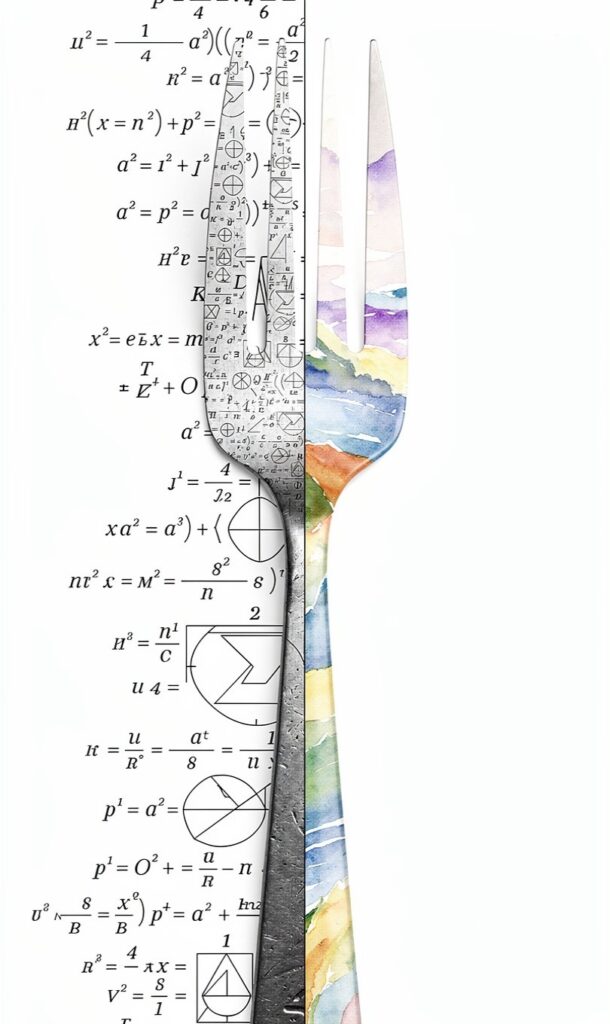
To isolate this vulnerability, David Hume again conducted an audit on the contents of the human mind, dividing all objects of human inquiry into two completely separate domains, a conceptual tool known in philosophy as Hume’s Fork
The first prong of the fork consists of Relations of Ideas. These are analytic truths that are true by definition, discoverable through pure, unassisted thought, logic, and mathematics. Say, for example, the statement “three times five is equal to half of thirty” or “a triangle has three sides” belongs to this category. The defining characteristic of a Relation of Idea is that its contrary implies an absolute logical contradiction. If you try to imagine a four-sided triangle, your brain experiences a total cognitive crash; it can not exist in any possible universe because it violates the fundamental laws of geometry. These truths are clean, certain, and independent of anything existing in the physical world.
The second prong of the fork consists of Matters of Fact. These are synthetic truths that depend entirely on empirical observation and real-world experience to verify. Statements like “the sun will rise tomorrow” or “fire will burn my hand” are matters of fact.
Crucially, Hume pointed out that the contrary of any matter of fact is always perfectly possible and never implies a logical contradiction. When you say “the sun will not rise tomorrow,” it may be a highly disruptive and terrifying thought, but it does not cause a logical crash in your brain like a four-sided triangle. It is a perfectly conceivable scenario that violates no pure laws of logic.
And Hume then asked: how do we trace our knowledge regarding matters of fact that go beyond the immediate testimony of our senses or the records of our memory? His answer was clear: all our reasoning about matters of fact is built entirely on the relation of cause and effect.
We see a black billiard ball strike a red one, and we watch the red one move. Our default mindware instantly invents an invisible link called “causation.” But if we perform a cold, strict audit on our actual experience, Hume said that we never actually see the causation itself. We only see a constant conjunction of events, Event A happening, followed immediately and consistently by Event B. And then we assume a deeper connection exists, but we can not trace it to anything other than sequence.
The Core of the Problem: The Principle of Uniformity
So this brings us directly to the core of the problem of induction. Every single time we use past experience to make a prediction about the future, our argument relies on a massive, hidden, unstated premise: The Principle of the Uniformity of Nature. This is the unyielding assumption that the unobserved parts of the universe must resemble the observed parts, that the future will always remain uniform with the past, and that the laws of physics will not spontaneously rewrite themselves overnight.
Just like I wrote some days ago, I would now say that Hume is acting as the intellectual devil’s advocate, and he asked a simple question: How do we then rationally justify our belief in this Principle of Uniformity?
If our belief is truly rational, it must successfully cross over one of the two prongs of Hume’s Fork. It must be either a Relation of Ideas or a Matter of Fact. So let us further audit both options:
First, can the Principle of Uniformity be justified as a Relation of Ideas? Absolutely not! Because, as we established, it is not a logically necessary truth. We can easily conceive of nature changing its course; we can visualize a world where gravity suddenly repels objects or where water behaves like gasoline. Because the opposite of a uniform nature implies no logical contradiction, because it can not be proven by pure thought.
Second, can the Principle of Uniformity be justified as a Matter of Fact? Can we say, “We know nature is uniform because it has always been uniform in the past”?
Hume exposed this as a massive, circular argument that begs the question entirely. To use past experience to prove that past experience is a reliable guide to the future is the psychological equivalent of trying to verify the validity of a fraudulent check by pointing to the word of the person who wrote it. You are using inductive reasoning to justify the validity of inductive reasoning. You are assuming the very uniformity you are trying to prove, trapping your intellect in a loop of causality.
Hume’s Sceptical Conclusion: Custom and Habit
When you follow Hume’s thought to its ultimate destination, you arrive at a conclusion that our belief in induction, our reliance on science, our trust in cause and effect, and our expectation that tomorrow will resemble today have absolutely zero foundation in human reason. Reason is completely blind in the face of the future.
But David Hume was a deeply practical philosopher. He did not conclude that we should throw up our hands in cynical defeat, abandon scientific exploration, or refuse to eat our next meal because we can not logically prove it will nourish us. Hume realized that while doubts make perfect sense when you are just sitting and thinking, real life forces you to take action anyway.
So instead, Hume’s conclusion was fundamentally psychological. He argued that our belief in induction is driven entirely by custom and habit.
Human beings are biological engines hardwired by natural evolution to seek out regularities and patterns and expect consistency. When we see a sequence repeat itself over and over again, our mind naturally builds a powerful habit of expectation. And so, according to David Hume, custom is the great guide of human life. It is an instinctual survival mechanism, a default code designed to keep us moving through the world without locking up in existential paralysis. We do not expect the sun to rise because we are rational; we expect it to rise because we are creatures of pure habit.
Why Does This Matter?
It is easy for a casual observer to dismiss the problem of induction as a trivial word game played by bored academics. But if you upgrade your mindware, thought process, and trace the systemic implications of this puzzle, you realize it strikes a blow to the very foundation of modern civilization.
First, it creates a massive crisis for the Philosophy of Science. The entire scientific method is built on taking a limited set of controlled experiments and expanding them into universal, untouchable laws of nature, such as Gravity, Thermodynamics, or Relativity. If induction carries no rational guarantee, then scientific laws are technically not absolute, objective truths; they are highly sophisticated, exceptionally accurate generalizations based entirely on past data trends. Science, the ultimate temple of human reason, is revealed to be resting on an underlying foundation of pure empirical faith.
And second, it exposes what the twentieth-century philosopher C.D. Broad famously labeled the “scandal of philosophy.” It is a profound embarrassment to human intellect that despite centuries of dazzling technological progress, brilliant mathematical breakthroughs, and deep philosophical structures, even though a hot stove burned us in the past, we can not logically prove it will burn us again next time. This shows we can never completely bridge the gap between what we expect in our minds and how the real world actually works. I know that last statement might sound funny, it does even to me too, but I hope you get the point.
Attempts to Solve It
Because the problem of induction is such a glaring vulnerability, many of history’s most powerful minds have deployed massive resources to solve, bypass, or dismantle Hume’s challenge.
The German philosopher Immanuel Kant was so deeply shaken by David Hume’s writing that he famously stated it “awoke me from my dogmatic slumbers.” Kant attempted to solve the problem by completely rewriting the map of epistemology (Epistemology is the branch of philosophy concerned with the nature, origin, and limits of human knowledge. It investigates the fundamental difference between justified belief and mere opinion, asking key questions like: What is knowledge? How do we acquire it? And What can we truly know?) He argued that things like cause, effect, space, and time are not things we discover out in the physical world; rather, they are the built-in structural lenses of the human mind itself. We experience a uniform world because our brain actively formats our experiences into a uniform structure before we ever become consciously aware of them.
In the 20th century, the philosopher of science Karl Popper offered a completely different strategy: he attempted to sidestep David Hume entirely by arguing that science does not actually use induction at all. Popper claimed that true science operates purely on deductive falsification.
While we can never use induction to prove a hypothesis is 100% true (no matter how many white swans we see), we can use a single, sharp deductive observation to prove a theory is false (seeing one black swan). Therefore, science progresses not by accumulating positive confirmations to build an illusion of certainty but by aggressively running audits on our theories to see if they can survive the fire of opposition.
Read Also: More Dangerous Than Evil: The High Cost of Intelligent Stupidity
Read Also: How to Become Intelligent Through Self-Experimentation
Read Also: The Civic Responsibility: You Hold No Authority to Question a System You Avoid
Conclusion
David Hume’s problem of induction forces us to confront a vital choice in how we manage our mental operating systems. We can allow the lack of absolute certainty to drive us into a state of paralyzed, cynical exhaustion, abandoning our discipline and treating all knowledge as a meaningless joke.
Or, we can choose to step up, accept the boundaries of our intellect, and build a highly calibrated, unshakeable sovereignty.
The lesson of induction is not that we should stop trusting science or abandon our daily habits; it is that we must completely purge our minds of the toxic, arrogant illusion of absolute dogmatic certainty. A truly high-value mind understands that our knowledge is a living, breathing hypothesis waiting to be continuously tested against the friction of reality. It forces us to approach our strategies, our convictions, and our characters with a deep sense of strategic humility.
So, my dearest readers, upgrade your mind, your thought process, your internal system. Clear out the lazy logic that mistakes a past streak of good luck for a permanent law of nature, delete the emotional illusions of comfortable safety, and ensure that your life is anchored, not in the soft fantasy of a guaranteed tomorrow, but in clear logic, active vigilance, unyielding conduct, and uncompromised intellectual sovereignty.