I think that potential can be one of the most dangerous words in the human language, because we carry it like a trophy, a shiny badge of what could be. But a TikTok video, I just saw, by Victor Okafor, suggests that potential, unactualized, and unrefined is essentially useless. It has no relevance in the marketplace, no utility in leadership, and no weight in character.
To transform into something of substance, one must undergo a difficult, counterintuitive process: entering a “voluntary prison.” You must give up the intoxicating freedom to be anything in order to subject yourself to the rigorous structure required to be something.
The Paradox of Choice and the Transition Phase
According to Victor Okafor, between the ages of 21 and 26, most young adults enter what is known as the transition phase; it is a period of maximum liberty. You have the energy of youth, the absence of heavy domestic responsibilities, and a world that tells you that you can be whatever you want to be.
But there is a trap in this infinite choice. If you spend your twenties trying to keep every door open, you eventually realize you have not walked through any of them. Liberty, without direction, leads to a vacuum.
And Victor Okafor points out that potential is merely a theoretical value. You might have the potential to be a world-class athlete, a brilliant surgeon, or a visionary entrepreneur. But until you submit to the transaction of hard work, that potential remains invisible. To make it visible, you MUST trade your liberty for structure. You must choose a “prison,” a specific discipline, an apprenticeship, or a taxing and demanding degree, and stay there until the work is done.
The Cost of Actualization
Actualizing your potential requires a brutal transaction. You are trading your time, your comfort, and your ability to “do whatever you want” for a specialized set of skills and a hardened character.
Consider the “rigorous structure” of a trade. Whether it is coding, carpentry, or financial analysis, mastery requires you to say “no” to a thousand other things. You are voluntarily restricting your movements. You are waking up at the same time, looking at the same problems, and failing at the same tasks until you eventually succeed.
And this, I will say, is the “friction” that the tagline, the “Do Better, Be Better” of Value Faith philosophy, thrives on. Without the friction of structure, your talent remains soft; it is only when you are squeezed by the demands of a specific path that your value begins to emerge.
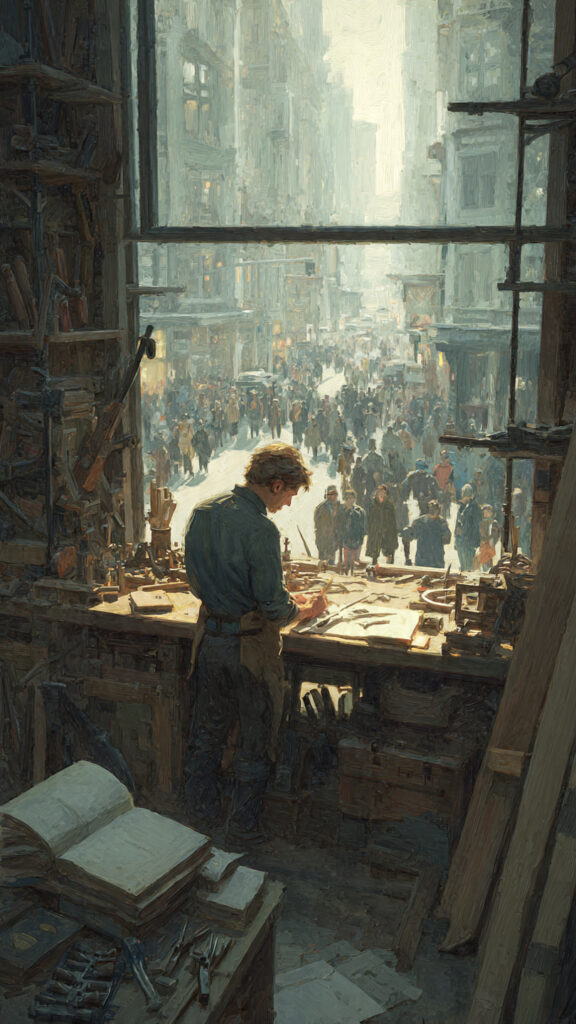
Remember a few minutes ago, when I said, and you read: “Actualizing your potential requires a brutal transaction, and to make it visible, you MUST trade your liberty for structure. You must choose a ‘prison,’ a specific discipline, an apprenticeship, or a taxing and demanding degree, and stay there until the work is done.” This reminds me of an article I wrote last year titled: The Dizziness of Freedom – Building Ourselves in The Anxiety of Choice.
Take a moment to look around you, soak it all in, open your eyes to see and realize that we live in an age of unprecedented freedom. With a world of choices at our fingertips from career paths and lifestyles to identities and beliefs, we’ve been handed the keys to our own destiny, but the thing is with this freedom can come a cost: anxiety.
Anxiety, because the more possibilities we face, the harder it can become to choose, and in the wind of “what if(s)” and “could be(s),” we often find ourselves dizzy, uncertain, and overwhelmed.
The philosopher Søren Kierkegaard called this the dizziness of freedom, a profound inner tension born not from a lack of options, but from the overwhelming presence of options. But he also believed that it is in this very anxiety that we come face to face with, that we can build our truest selves, and that it is what I want us to talk about.
And so I want you to walk with me or better still, let sit on a bench in the park, just me and you, I can already picture that too, Lol, and I hope you have the picture in your head, while we explore how freedom and anxiety can feel inseparably linked, and why this tension is central to the human experience, and how embracing it can lead to a more authentic, meaningful life.
Kierkegaard observed that true freedom does not feel light and necessarily liberating, it feels like dizziness. When faced with the vast possibilities that freedom opens up, we are often left spinning. And why is this? Because every choice we make excludes countless others, every decision, no matter how small, closes a door to an alternate path we will never know.
Continue Reading: The Dizziness of Freedom: Building Ourselves in The Anxiety of Choice
The Man-Child Warning
What happens if you refuse the voluntary prison? What if you decide to keep your “freedom” and avoid the demanding and exhausting nature of structure?
Victor Okafor warns of the “man-child” syndrome. It is likely that we have all met them, individuals in their 40s, 50s, or even 60s who are still “full of potential.” They have a hundred half-started projects and a thousand excuses for why they have not made it yet. They refused to subject themselves to a trade; they stayed in the “potential” phase so long that their potential, youthfulness, and energy eventually expired.
Time is the one variable we can not negotiate. And Victor Okafor went further to quote Jose Mourinho: “Yesterday I was 20; today I am 56.” The window to enter the voluntary prison and build a foundation is narrow. If you do not choose your structure in your twenties and thirties, the world will eventually choose a lack of relevance for you.
The Cautionary Tale of Dele Alli
According to Victor Okafor, the world of sports provides a vivid picture of this concept. Victor points to the professional decline of an amazing footballer, Dele Alli, as a sad example. As of this moment, as I write this article, Dele Alli’s contract with Como 1907 was terminated in September 2025, and he has been training at Tottenham Hotspur to maintain fitness. Trust me, as a fan of Dele Alli, I wish him the very best. At a young age, Alli was the personification of potential; he was gifted, fast, and obviously destined for greatness.
But talent is a seed, not the harvest. Somewhere along the way, the “transaction” of continuous, rigorous subjection to the trade was interrupted. When the structure of discipline fails, even the greatest talent loses its joy and its place on the field. It serves as a reminder to me, and my dearest readers, it should serve as a reminder to you too, that the voluntary prison is not a one-time sentence; it is a lifestyle of choosing the hard path over the easy one every single day.
If you work hard and are dedicated and do not abandon your goals, you’ll achieve them eventually.
The urge to write about why hard work is key to success began after Burna Boy had a chat with his followers through Instagram Live. In the course of the conversation, he stated:
“If you no make am no evidence say you try your best.” “You go dey explain tire.” “You go explain explain explain because no evidence say you try your best if you no make am.”
In simple terms:
- “You go explain tire” – You’ll continue to explain yourself.
- “No evidence” – There’s no evidence of your saying.
This saying applies to many different aspects of life but is especially applicable in the context of perseverance and hard work.
How many times have you heard that hard work is the key to success? It’s likely to be a lot, and it’s true! The importance of hard work is paramount to success, and it’s due to many reasons.
Be determined, work hard, and you’ll be able to accomplish anything. This is a phrase which has been said to us over and over again, and it’s almost lost its significance. The issue is that we’re already feeling as though we’re doing our best, and for a lot of people, it feels like they are not making any progress.
“Hard work” isn’t just physical, it’s emotional too.
Continue Reading: Why Hard Work Is Key To Success | Quotes
Building Your Future with Today’s Restraint
When you choose to subject yourself to a path, whether it is a spiritual discipline, a career, or a craft, you are not losing your future; you are buying it.
The freedom you enjoy in your 40s and 50s is built on the restraint you exercised in your 20s. The authority you carry later in life is the direct result of the subjection you accepted earlier.
- The Christian Perspective: We see this in the life of Jesus, who spent thirty years in the “structure” of a carpenter’s home and the study of scripture before beginning a three-year ministry that changed the world.
- The Stoic Perspective: We see this in the discipline of the mind, voluntarily restricting our reactions and desires to build an inner fortress that the world can not shake.
Obviously we all crave freedom; the freedom to choose; the freedom to live how we want, and the freedom to become who we know we can be.
But here is an amazing paradox, one that Dr. Jordan B. Peterson states very very plainly: “To be free, you must first discipline yourself.”
It sounds contradictory at first, right? How can restraint create freedom? How can rules lead to liberation? And how can discipline, which feels restrictive, be the very thing that unlocks your potential? But once you observe your life with and in all honesty, you realize this truth: Freedom is never possible without structure, self-mastery, and discipline.
Think about someone who says:
- “I am free to eat whatever I want!” But soon their “freedom” becomes sickness, low energy, and regret.
- “I am free to spend my money however I want!” But that “freedom” becomes debt, stress, and lack of options.
- “I am free to do what feels good!” But that becomes addiction, chaos, and shattered relationships.
This is the truth: A life without discipline does not produce freedom; it produces bondage.
When you lack structure, something else becomes your master: cravings, impulses, emotions, laziness, distractions, comfort, and other people’s expectations
Your life becomes reactive instead of intentional, and that is the opposite of freedom.
Continue Reading: The Freedom Paradox: Restraint is The Path to Freedom
Read Also: The Strength, The Struggle, and The Growth: The Lessons From Nietzsche’s Tree
Read Also: A Man Diligent In His Business
Read Also: The Terms of Service: Why We Serve God on His Terms, Not Ours
Conclusion
The transition from anything to something is painful. It feels like a loss; it feels like you are being caged while everyone else is out living their best life. But do not be deceived by the illusion of liberty.
A bird that never lands to build a nest eventually falls from exhaustion. A river that refuses the structure of its banks becomes a swamp. You were meant for more than just potential; you were meant for actualization.
So to myself, and to you, my dearest readers, I want to say, or rather scream at the top of my voice, as I say: Stop carrying your potential like a trophy! Put it on the altar of discipline! Enter the voluntary prison of your chosen craft! Subject yourself to the teachers! Subject yourself to the long hours! And the rigorous standards required for mastery!
Because the truth is simple: If you do not give up your freedom today, you will not have the liberty of a future worth living tomorrow.