Today, so many of us have developed a highly sophisticated vocabulary for our own compromise. In today’s culture that values immediate gratification, fluid boundaries, and the path of least resistance, we have mastered the art of talking ourselves out of our own convictions. We do not abandon our moral frameworks overnight, but instead, we dull them with a thousand tiny concessions, each one wrapped in a neat, modern-day packaging.
We look at a minor ethical shortcut at work, a small indulgence in a habit we promised to quit, or a momentary drift into bad faith, we shrug our shoulders, and we say to ourselves, and to anyone who dares to hold us accountable: “Relax, it’s not that deep.”
But this is a dangerous delusion, and it is maybe the single most toxic lie we can tell our souls.
I was forcefully reminded of this reality recently when I stumbled upon a piece of music that completely arrested my attention. It is a video titled “Sunday Service Freestyle Pt. 4” by the incredibly talented Christian rapper and singer, Nikki, also known as Nikki_G02 on socials. In the song, she delivers punchlines of rhythmic and spiritually sharp critique of the modern tendency to minimize our daily compromises. She captures the exact frame of our internal justifications: “A little of this, a little of that; You know it’s a sin, but it’s not that deep.”
Her freestyle exposes how our character erodes. The danger is not that we consciously choose to drown in chaos; the danger is that we assume we can dive into the pool of compromise and somehow remain completely dry. When we say “it’s not that deep,” we are not stating a factual measurement of the situation; we are just attempting to lower the stakes so we can indulge in it without feeling the weight of our guilt.
The Slip: “A Little of This, a Little of That”
To understand why this lie is so effective, we have to look at how temptation actually operates within human psychology. Very few people are destroyed by monumental temptations that arrive out of nowhere with horns and a pitchfork. If a massive, life-altering betrayal or an obviously destructive habit presents itself plainly one afternoon, our internal defense systems, our conscience, our upbringing, and our moral blueprint will instantly trigger an alarm. We will fight back because the stakes are undeniably high.
That means that structural erosion mostly happens incrementally. It requires what Nikki calls the method of “a little of this, a little of that.” It is the strategy of the micro-dose. If you take a drop of poison, you do not drop dead immediately, but your body processes it, handles the discomfort, and moves on. And because you survived without an immediate catastrophe, your brain flags the experience as relatively safe. And so, the next time, you take two drops, then three, and you slowly build a tolerance to the very thing that is destined to corrupt you and, worse, kill you.
This is the exact psychological mechanism behind the “Invisible Drift.” You are running a specific race, a race of character, faith, and intentional living. But you do not fall off the track only because you suddenly decide to turn around and run backward. You also fall off track because you allow yourself to drift by just half a degree to the left to chase a small indulgence.
Half a degree of variation feels like absolutely nothing in the first mile, but if you look at your trajectory after ten steps, you are practically side-by-side with the person who stayed perfectly on course, in their own track. You can look at them, smile, and say, “See? I took a little shortcut, but I am still right here. It’s not that deep.” But if you maintain that half-degree variance over a journey of ten miles, you will wake up miles away from your intended destination, lost in a forest of complications you never planned to inhabit. So that small indulgence was just a seed, and as Nikki Guz brilliantly said in her lyric: “Your problem likely started small: Small plants, small water, suddenly it grew up tall.”
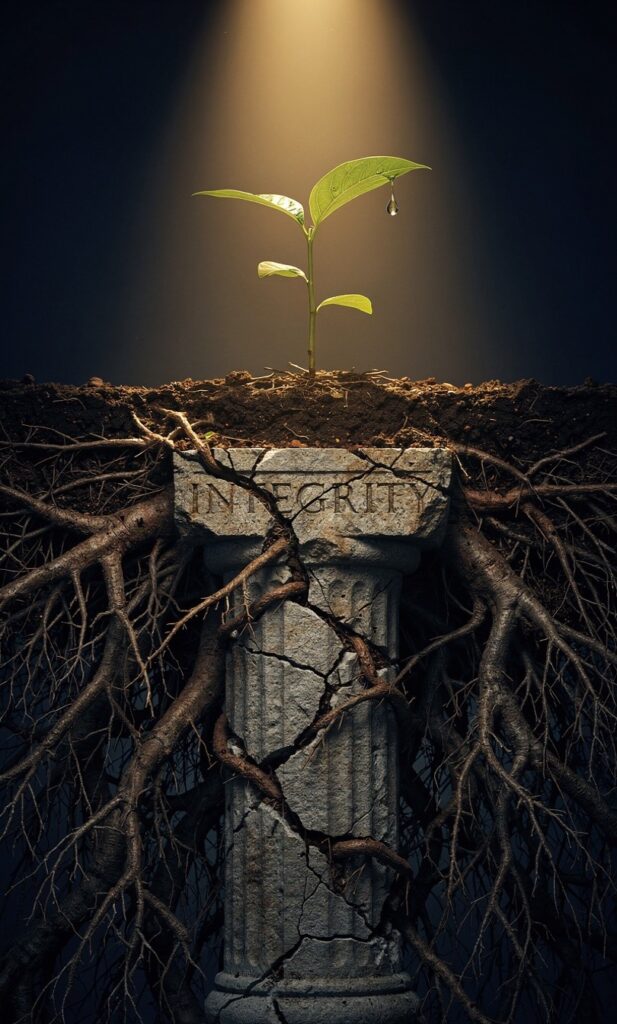
The Deception of the Seed: Small Plants, Small Water
You can not control the size of the harvest once you have chosen the nature of the seed. When you plant a seed in the ground, you are handling something microscopic, clean, and easily managed. You can hold a mustard seed between your thumb and forefinger, and it is entirely hidden. It does not look like an obstacle; it does not look like a threat, but if you drop it in the soil and pour a tiny cup of water over it, you feel completely in control of the interaction.
This is what an initial compromise feels like. A little bit of gossip here, a tiny exaggeration on your tax forms there, a small digital indulgence in the dark when nobody is watching. It is just a “small plant.” And it only requires a “small water,” just a tiny bit of your attention, time, and mental justification.
But what we completely fail to realize is that the seed carries an internal, automated blueprint of exponential growth. The seed does not ask for your permission to grow tall; it simply obeys the natural laws of compounding development. The soil of your mind does not care whether you plant a fruit tree or a toxic weed; it will nourish whatever you drop into it with equal efficiency.
And suddenly, five years down the line, that tiny, managed compromise has grown into a massive oak tree of dysfunction that completely blocks out the sun. The roots have wrapped themselves around the foundation of your character, cracking the concrete of your integrity. And the branches are heavy with the bitter fruit of anxiety, secrecy, and fractured relationships.
And then, you stand beneath the shadow of this massive problem, wondering how your life became so complicated, so heavy, and so full of suffering.
The answer is found in the mirror, and it grew tall because you watered it many, many times with the phrase “it’s not that deep.” You treated an invasive weed as if it were a harmless houseplant until the weed became the master of the house.
The Illusion of Control
The third major pillar of Nikki Guz’s critique points to the arrogance of the human ego when dealing with compromise. In her freestyle, she drops a line that, in my opinion should be carved into the desk of anyone trying to get their act together: “Must be a fool to think you could dive in sin but not drown in that pool.”
This exposes the grand illusion of the modern mindset: the belief that we can participate in chaos without becoming chaotic. We look at the environments around us, the corporate cultures built on deceit, the social media spaces defined by performance and outrage, the circles of friends who bond over cynical mockery, and we tell ourselves that we are strong enough to swim in those waters without absorbing the temperature of the lake. We think we can “dive in” for a swim, enjoy the thrill, sample the pleasures of the flesh, and then pull ourselves out onto dry land whenever we please.
This is an intellectual and psychological impossibility. Your character is an adaptive system; it can not spend hours submerged in a toxic environment without breathing in the poison.
And so, when you dive into a pool, you are initially hyper-aware of the water. You feel the wetness, the temperature shift, and the resistance against your skin. But if you stay in the pool long enough, something dangerous happens: Your nervous system adapts. The water stops feeling cold. You adjust to the pressure. And you forget what it feels like to stand on dry land in the fresh air.
This adaptation is what psychologists call desensitization, and it is the exact process by which the soul dies. The first time you compromise on a core value, your conscience screams. You feel sick to your stomach, and you can barely sleep at night because your internal blueprint is completely out of alignment.
But if you suppress that scream by telling yourself “it’s not that deep,” the next time you commit the same infraction, your conscience will not scream; it will whisper. The third time, it will stay silent, and by the tenth time, the behavior feels completely normal, completely natural, and entirely justified.
And at this point, my dearest readers, you have not mastered the water; the water has mastered you. You are not swimming anymore, you are drowning. And the ultimate tragedy of drowning in compromise is that it happens so slowly and so comfortably that you do not even realize you are losing your breath until your lungs are already full of mud.
Even now, I remember the exact moment I first encountered and read those words a few months ago. It was not in a grand church or building, or at a motivational seminar; it was a quiet collision between my eyes and a sentence that seemed to vibrate with a haunting, ancient authority, or at least that was how it felt, and still does. Since that day, it has been weighing on my heart like a stone that refuses to be moved. I have carried it into my mornings and let it settle over my restless nights; it is a sentence that strips away every excuse I have ever made and leaves me standing naked before my own conscience. It whispers to me in the silence of my reflections, reminding me of the ultimate tragedy: “Your worst sin is that you have destroyed and betrayed yourself for nothing.”
We spend so much of our lives guarding against external enemies; we pray for protection from those who might harm us; we build walls against critics; and we navigate the bad paths of the world, hoping to remain untainted. But follow me for a moment, my dearest readers, what happens when the enemy is not at the gate? What happens when the person dismantling your destiny is the one staring back at you in the mirror? We often think of betrayal as something done to us by a friend or a stranger, but the most lethal betrayal is the one we commit in the privacy of our own choices. When I look at the habits I have allowed to persist and the discipline I have let slip, the mirror does not lie, and so again I am reminded of the statement “Your worst sin is that you have destroyed and betrayed yourself for nothing.”
There is a profound, almost terrifying realization in acknowledging that I am the architect of my own undoing. Every time I chose comfort over my calling, I was not just “resting,” I was chipping away at the foundation of the man I was meant to become. Every time I silenced my inner voice to appease a crowd or fit into a system that did not value my soul, values, virtues, and beliefs, I was committing an act of spiritual treason. We think these are small, inconsequential moments, but they are the bricks used to build a prison of our own making.
When you realize that you have surrendered your birthright for a temporary seat at a table where you were never truly welcome, or where your soul never should have walked, the weight of that choice becomes unbearable, and that again reminds me of the statement “Your worst sin is that you have destroyed and betrayed yourself for nothing.”
Continue Reading: The Mirror’s Accusation: When the Person You’ve Betrayed is Yourself
Resembling Saul: The Tragedy of the Divided Identity
When we live a life of incremental compromise, balancing a little bit of faith with a little bit of flesh, a little bit of public testimony with a little bit of private idolatry, we end up creating a deeply fractured identity. Again, back to her track, Nikki Guz uses a powerful biblical metaphor to describe this state of being, warning that when you live for modern idols under the guise of freedom, “it looks like resembling Saul.”
King Saul is one of the most tragic figures in the bible and ancient literature, not because he started out evil, but because he was a master of the partial victory. When given clear instructions to completely eliminate a corrupt system, Saul decided to keep the best cattle and the most valuable loot for himself, destroying only what was cheap and worthless. And when confronted by the prophet Samuel, Saul did not say,“I rebelled against God.” Instead, he confidently declared,“I have performed the commandment of the Lord.” Saul genuinely believed his own lie. He thought that 90% obedience was good enough, and he thought that keeping a few shiny things on the side was guess? “Not that deep.”
But partial obedience is just a decorated form of complete rebellion. Saul’s refusal to manage the small details of his character, his insecurity, his need for human approval, his hunger for immediate spoils, eventually caused a complete psychological and spiritual collapse. He spent the latter half of his life consumed by paranoia, hunting down his own friends, and consulting mediums in the dark, a hollow shell of the king he was designed to be.
When you try to live life your own way while maintaining a surface-level appearance of order, you are resembling Saul. You are building a facade, and you are checking the boxes of the “Sunday service” while running a completely different script in the background.
And this divided lifestyle is a massive drain on your psychological battery. It takes an immense amount of cognitive energy to maintain a double standard, to ensure that your private life never accidentally leaks into your public square, and to keep suppressing the quiet voice of truth that tells you you are living a lie. You can not make the cut in the race of life if you are dragging the dead weight of an unexamined identity behind you.
At some point in our lives, we have all been there and done it. I have for sure had a double standard, but recently I thought very deeply about it. I remember back in my university days, I had an issue with a friend, which I will not be going into details, but it was very much about my standards. I was not willing to take the road I disagreed with because, for that particular event, it was the same thing as having a double standard and not practicing what I preached.
Fast forward to just recently, I had this friend that I helped in making a decision that was again against what I preached, and I was very much aware of this, it got me thinking, where do we draw the line and how much of a standard do we really have depending on the price of compromising?
Now sometimes this double standard can be a form of bias, and sometimes it is so small that we might not even see it because it sometimes takes a high level of consciousness to spot these things, but in my case it was obvious, and I felt this unease inside of me, so I decided to ask this friend to know if they see it as having a double standard because this is someone I know who likes to set standards too, but unfortunately they did not feel a flinch with the decision, masking it in the “its for the greater good” slogan.
Continue Reading: Double Standard Is No Standard At All
Read Also: The Tyranny of Small Decisions: The Dangerous Power of the “Just This Once” Mindset
Read Also: Stacking the Evidence: How to Become the Man You Think You Are
Read Also: Stop Suffering! The Urgent Case for Getting Your Act Together
Conclusion
Every single day, the world presents us with an unannounced test, and it asks us a very simple question: “Who are you, and what do you actually stand on?”
If your starting points, your axioms, are fluid, if they change depending on your mood, your environment, or the pressure of the crowd, then you will eventually fail the test. You will look at the small compromise and say, “it’s not that deep,” completely oblivious to the fact that you have just dropped a toxic seed into the soil of your future.
My dearest readers, it is time to stop the stupid suffering of incremental compromise. It is time to listen to the raw, uncomfortable truth delivered so clearly by voices like Nikki: you can not play games with the details of your character and expect to build a life that stands strong in the storm.
Take an honest audit of your life right now! Look at the “small plants” you have been watering in secret! Look at the little shortcuts you have been justifying! Stop calling them “minor mistakes!” Stop telling your soul that it does not matter!
It is that deep! It is as deep as your destiny, your character, and your eternal peace. So drop the double life, throw out the malware of your small excuses, and choose to be a person whose internal blueprint matches their external walk.
Stop drifting! Stand your ground! Stay on course! Start today! Start now!
New International Version
1 Corinthians 9:27
No, I strike a blow to my body and make it my slave so that after I have preached to others, I myself will not be disqualified for the prize.
New Living Translation
I discipline my body like an athlete, training it to do what it should. Otherwise, I fear that after preaching to others I myself might be disqualified.
English Standard Version
But I discipline my body and keep it under control, lest after preaching to others I myself should be disqualified.
Berean Standard Bible
No, I discipline my body and make it my slave, so that after I have preached to others, I myself will not be disqualified.