I know many of us like to tell ourselves that we are fine. We tell our friends, “It is all good,” and we tell our mirrors that we will start tomorrow. We treat self-improvement as if it is a luxury, a hobby for people with too much time on their hands, or a peculiar obsession for the “hustle culture” devotees, but that, my dearest readers, is a dangerous delusion.
The truth is far more objective and far more urgent. Getting your act together is not about becoming “perfect” or winning a productivity award; it is an act of self-preservation. When we live in chaos, we are not just being messy; we are choosing to suffer in ways that are entirely preventable. And even worse, we are literally suffering stupidly.
The Why: Reducing Unnecessary Suffering
If we are being honest with ourselves, life is already difficult enough. By its very nature, existence involves a baseline of hardship, loss, aging, and the inevitable challenges of the human condition. This is what is called “the necessary suffering.” However, most of us are currently carrying an extra 50% of weight that we do not have to carry. We are suffering because our taxes are not done, our relationships are strained by unsaid words, and our physical environments are so disorganized that they drain our mental energy before we even leave the house.
Some of us might even claim that we “do not care” about these things. We say we are “free-spirited” or that “a little mess does not bother us.” But this is a lie we tell ourselves to avoid the work of discipline, because the reality is that while we might not really care about the mess today, oh, my friend and dearest readers, we will so very, very much care deeply when that mess transforms into a crisis.
Trust me when I say that pain is the great truth-teller. You might think you do not care about your health until you are in excruciating pain in a hospital bed. You might think you do not care about your finances until you are staring at an eviction notice. And at that moment, your so assumed “philosophical indifference” vanishes. You suddenly wish, with everything you have, that you had taken the small, boring, disciplined, and hardworking steps to avoid that moment.
The “Why” of getting your act together is to reduce the total amount of agony in your life. And so, by organizing yourself, you are not just becoming “more productive,” you are building a buffer and a shield between yourself and the inevitable catastrophes of life. You are deciding that you have enough problems already, so you might as well fix the ones you actually have control over.
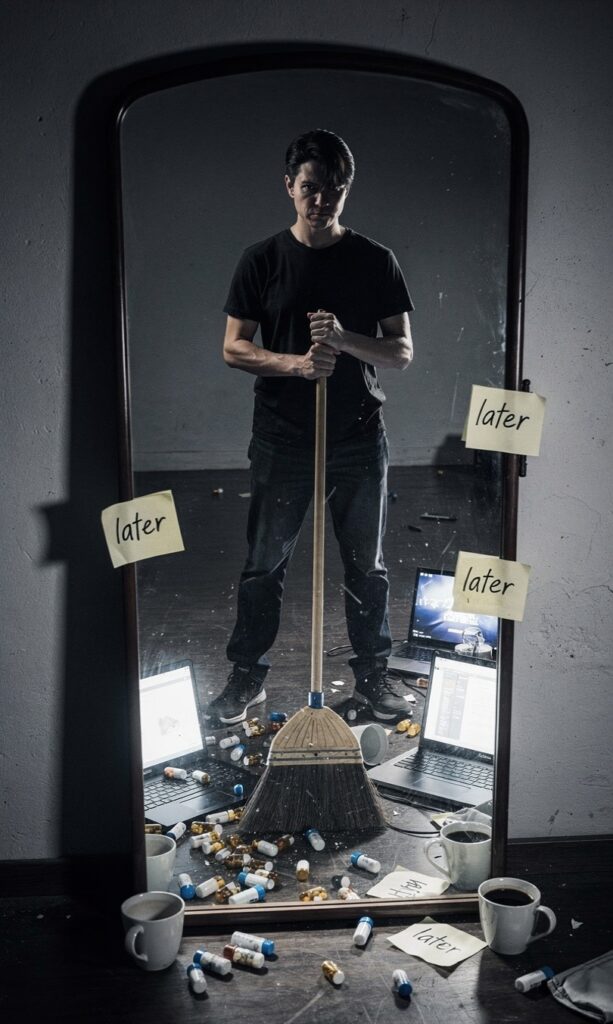
The How: Fix What Bothers You
This process of perceptual repair is actually a way of training your brain to see the world as a series of solvable problems rather than an overwhelming wall of chaos. When we ignore that flickering lightbulb or the pile of laundry, we are not just being lazy; we are practicing the art of blindness. We are telling our subconscious that we are the kind of people who see things that are wrong and choose to do nothing. And this has the ability to erode our self-trust and feeds the “stupid suffering” that is obviously very, very avoidable.
By engaging in the “Bedroom Meditation,” we start to reverse this erosion. You will find that as you fix the physical space around you, your mental space begins to expand. And this is because your brain does not differentiate between “external” chaos and “internal” anxiety as much as you might think. A cluttered desk is, to your nervous system, a cluttered mind. When you clear the physical “perceptual bugs,” you are essentially freeing up RAM in your mental computer, your brain.
Plus, this practice builds what psychologists call self-efficacy. Each time you complete a ten-minute task, like finally filing those papers or scrubbing a stained countertop, you are providing yourself with objective evidence of your own competence. You are no longer just thinking about being a more organized person; you are actually being one. And this builds a feedback loop: The more small things you fix, the more you trust yourself to handle larger things. And eventually, you stop looking for things to fix and start seeing the world through the lens of potential order. You realize that you have the agency to change the local limits of your being, and once you realize you can fix your room, you start to wonder what else in your life has been waiting for a ten-minute repair. And this reminds me of the article: Stacking the Evidence: How to Become the Man You Think You Are
Most men carry a secret “hero fantasy” in the back of their minds. It is like a vivid mental movie where, in a moment of extreme crisis, a home invasion, a public assault, or a natural disaster; they transform into a selfless, tactical, and fearless protector. In this fantasy, they are the man they want to be: brave, decisive, and capable.
But as @apeacefulknight on Tiktok sharply argues, there is a dangerous gap between who we imagine ourselves to be and who we actually are in the mundane, uncomfortable moments of Tuesday afternoon. If you are not “stacking the evidence” for your bravery in small, social ways, you are likely lying to yourself about your capacity for heroism in the large, physical ways.
The greatest lie we tell ourselves is that character is something that shows up during an emergency. We believe that when the stakes are high enough, our adrenaline will override our insecurities and turn us into a lion.
But in reality, character is a muscle built through thousands of boring repetitions. And if you can not muster the courage to have an uncomfortable conversation with a friend who is being disrespectful to women, you have zero evidence to suggest you would have the courage to face a violent criminal. Bravery is not a light switch you flip; it is a lifestyle you maintain.
When you live in a fantasy of future heroism, you are actually using that fantasy as a get out of jail free card for your current cowardice. It is easy to say, “I would die for my family,” but much harder to live for them by being the kind of man who calls out toxic behavior that creates a dangerous world for them in the first place.
Continue Reading: Stacking the Evidence: How to Become the Man You Think You Are
The Compound Effect of Small Repairs
This shift in perspective is what fundamentally changes the trajectory of a person’s life. When we talk about 100 small repairs, we are describing the transition from a state of passive (entropy) disorganization and randomness to one of active stewardship. Entropy is the natural law that things fall apart, dust gathers, relationships struggle, and systems fail if left unattended. And by committing to these small, frequent interventions, you are essentially declaring war on entropy, disorganization, and randomness. You are no longer waiting for a “moment of inspiration” to change your life; you are relying on the mechanical certainty of incremental gain.
Consider the psychological weight of “unfinished business.” Most of us carry around a mental backpack full of rocks, unanswered emails, a squeaky door hinge, an overdue bill, and a messy junk drawer. Each of these rocks may be light, but together, they make it impossible to run. But as we perform these small repairs, we are removing those rocks one by one, and we will begin to find out that the weight lightens, and our speed increases. The energy we used to spend suppressing the sight of that messy drawer is now available for higher-level creative work or deep presence with our family. And this is why competence “spills over,” because the discipline required to organize a bookshelf is the exact same cognitive pattern and discipline required to organize a business strategy or a complex conversation. You are sharpening your blade on the small things so that when the big things arrive, the “storms” of life, you are ready to take them head-on.
And this practice acts as proof against catastrophe. Most of the monsters we face in life, bankruptcies, divorces, and health crises, do not appear out of nowhere. They are usually the result of 1,000 small repairs that were never made. A marriage does not end because of one argument; it ends because of 10,000 unsaid “I am sorrys” or unfixed resentments. But by handling the small chaos today, we are essentially engaging in a form of preventative maintenance for our souls. We are building a fortress not by looking at the horizon, but by ensuring that every single brick in our immediate reach is set straight. My dearest readers, when we live this way, we realize that the “stupid suffering” was never a requirement of life; it was simply the interest paid on the debt of ignored responsibilities. But by paying that debt in small, ten-minute increments, we buy back our future. And this, again, reminds me of another article: Poverty Charges Interest: Why Ignoring Today’s Needs Costs Tomorrow
Some people treat poverty as a static condition, a temporary inconvenience, a challenge to endure, or worse, a lifestyle to accept. But poverty is not just about the lack of money today; it is about the compounding consequences of neglect. And the truth is simple: Poverty charges interest, and the longer you delay investing in yourself, your health, or your responsibilities, the higher the cost becomes.
When you skip small but essential expenses today, it almost always leads to bigger, unavoidable costs tomorrow. For example:
- Health: If you can not afford basic dental care now, you may face expensive root canals later. Skipping annual checkups or ignoring early signs of illness can escalate into critical medical bills.
- Comfort and Rest: A worn-out mattress might seem like a minor expense, but poor sleep over time can contribute to severe health problems, from back issues to weakened immunity, and eventually requiring costly treatment.
- Home and Safety: Delaying repairs or maintenance may seem like saving money, but it almost always results in structural damages that are far far more expensive to fix later.
So in essence, poverty is not just a present problem; it accumulates penalties over time, just like interest on a loan.
Continue Reading: Poverty Charges Interest: Why Ignoring Today’s Needs Costs Tomorrow
Read Also: Cost of Aimlessness: Why Your Brain Needs a Goal to Stay Sane
Read Also: The Mandate for The Formidable Character with Virtue
Read Also: The Tragic Dream of the Aspiring Oppressor
Conclusion
And so, again, my dearest readers, getting your act together is not a suggestion; it is a moral obligation to your future self and the people who depend on you. We have enough unavoidable pain in this world; there is no reason to add to it through our own negligence.
So take a look around you right now. What is one thing you are currently ignoring? What is one small repair that is announcing itself to you? Fix it! Do it now! Do not wait for a “new version” of yourself to arrive. Use the version of you that exists today to make things at least just 1% better.
Because by fixing what bothers you, you are deciding that your life is worth the effort. You are moving from a state of passive suffering to a state of active competence. Stop suffering stupidly! Start where you are!
At some point in our lives, there is something honest and maybe uncomfortable we all have to admit: We already know what needs to change! We know the habits that are holding us back! We know the patterns that are weakening our character! And we know the decisions we keep postponing!
And yet nothing happens; we think about it, we talk about it, and we even feel convicted about it. But we delay, and that delay becomes a pattern.
There is a quiet awareness inside each of us, and it tells us when something is not right, when we need to change this or that, and when we can not keep going like this. And for a moment, we listen, we feel it clearly, but then something happens. We push it aside, and we tell ourselves:
- “I will deal with it later.”
- “I just need more time.”
- “I am not ready yet.”
And just like that, clarity turns into delay. And one of the most dangerous phrases we use is simple: “One day.” One day, I will fix this. One day, I will become better. One day, I will take it seriously.
Continue Reading: You Know What to Fix and Now is the Time!