For some of us, we like to keep a track of time; we track it with atomic precision on our smartphones, schedule it into digital calendars, because we feel the constant pressure of the hustle culture that tells us that every second must be productive. But most of us are only tracking one kind of time, the quantitative passage of minutes and hours, and the ancient Greeks called this Chronos.
But there is another kind of time, one that is not measured by the ticking of a clock but by the weight of a moment, and this is what the ancient Greeks call Kairos. It is the opportune moment, the “right” time that can change the trajectory of a life. But recognizing Kairos is not a matter of luck; it is a skill developed through Phronesis, or practical wisdom.
To live a life of meaning and impact, we must move beyond simply managing our schedules and begin mastering the art of the moment.
The Two Faces of Time: Chronos vs. Kairos
To understand why timing is a skill, we must first differentiate between the two Greek concepts of time, because they represent entirely different dimensions of human experience.
Chronos is chronological time, the relentless, ticking clock that governs our schedules and deadlines. It is sequential, linear, and fundamentally indifferent to human emotion or significance. It is the time that passes while you are waiting for a bus, sitting through a routine meeting, or watching water boil. Chronos represents the quantity of life; it provides the structure of our days, telling us exactly how long an event lasts, but it remains silent regarding that event’s value or meaning. In the world of Chronos, every second is identical to the one that preceded it, making it a measurement of duration rather than impact.
But Kairos, on the other hand, operates on a completely different plane. It is qualitative time, the “opportune” moment that demands a specific action. The term has deep roots in ancient Greek culture; in the context of archery, Kairos referred to the narrow window of space and time where an opening appeared in an opponent’s armor, or the precise instant an arrow had to be released to strike a moving target. For instance, you can say it is the “critical moment” where a speaker says exactly what needs to be heard to sway a crowd or change a mind. Unlike the steady march of Chronos, Kairos is non-linear and unpredictable; it is the “golden opportunity” that does not care about your calendar.
Kairos is the heavy silence in the breath before a difficult apology, or the sudden, sharp intuition that tells a founder to pivot their entire business strategy just as a market shift begins to ripple. It is the moment when it seems like the universe seems to pause only because it is waiting for your decision, and not just any decision, your right decision. While Chronos is a resource we try to “save” or “spend,” Kairos is a window we must “seize.” Because Kairos is fleeting, it possesses an urgency that Chronos lacks, and if you hesitate, over-analyze, or blink, the window slams shut and the moment vanishes into the past, never to be reclaimed in the same form.
This is why viewing time solely through the lens of clocks and calendars is a fundamental mistake. We can be a master of Chronos, punctual, organized, and efficient, while remaining completely blind to Kairos. True mastery of life requires shifting from being a mere time-keeper to becoming a time-perceiver, learning to recognize when the linear flow of the day has been interrupted by a moment of profound potential. Identifying this “right time” is the ultimate competitive advantage in both personal relationships and professional endeavors, as it allows us to act with a precision that raw effort alone can never achieve.
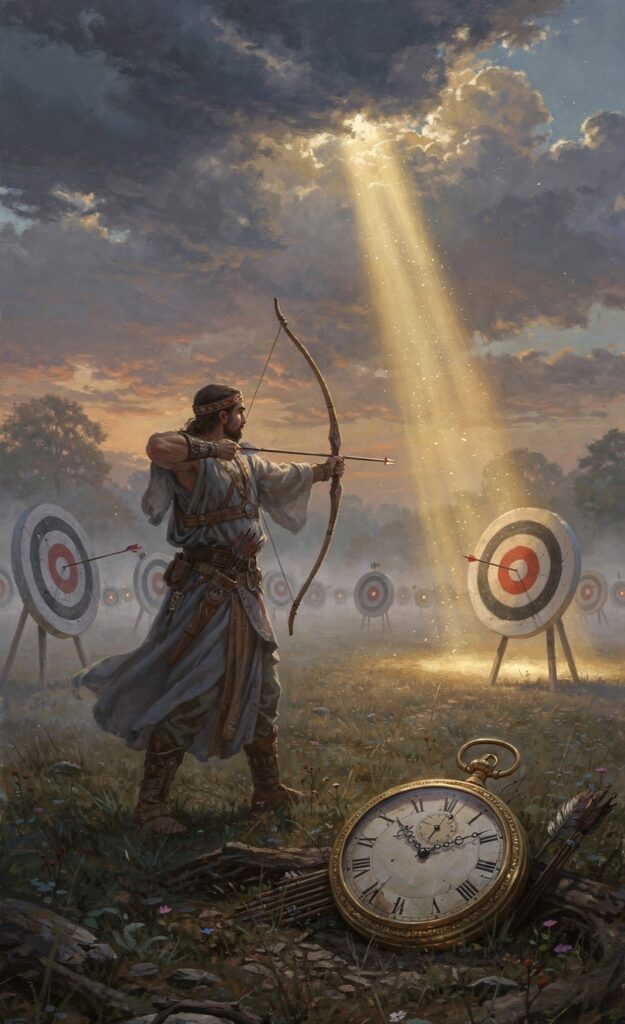
Phronesis: The Eye for the Moment
Phronesis is the bridge between abstract virtue and concrete action. While Sophia deals with universal truths and the “why” of the universe, Phronesis is concerned with the “how” of a human life well-lived. It is sometimes described as the “eye” of the soul because it provides a form of moral perception. Just as a seasoned sailor does not just look at the sea but perceives the specific way the wind is hitting the waves to predict a storm, a person with Phronesis perceives the social and emotional “weather” of a situation. This form of wisdom is inherently messy because it deals with variables that are constantly shifting, human emotions, conflicting interests, and the unpredictable nature of chance.
To grow in Phronesis, we must move beyond the safety of rules. Rules tell us that honesty is a virtue, but Phronesis tells us whether a specific moment requires the “brutal truth” or a “gentle silence.” It is the discernment that prevents virtue from turning into vice; without Phronesis, courage can become recklessness, and kindness can become enabling. It is essentially a skill of “sizing up” a situation. And this involves a rapid, most times intuitive integration of our past experiences, our current observations, and our future goals. When we stand at the intersection of a difficult choice, Phronesis is the internal compass that points toward the “mean,” the perfect middle ground between two extremes. It is what allows a leader to see that a mistake by a subordinate is not a time for a reprimand, but a Kairos moment for a lesson that will stick for a decade. It transforms our relationship with time from a passive endurance of minutes into an active, creative engagement with our circumstances.
Through the lens of Phronesis, we stop asking “What is the rule?” and start asking “What does this moment, with this person, require of me right now?” And this is the true essence of intellectual agency: The refusal to be a bystander in your own life and the commitment to developing the sharp, practical insight necessary to pounce when the universe presents an open door.
Why Timing is a Skill, Not Luck
Many people view great timing as a stroke of luck, like being in the right place at the right time. Even though fortune plays a role, our ability to recognize and seize that moment is a high-level skill.
Awareness over Automation: Most people live in a state of “automated Chronos.” They follow routines so strictly that they become blind to the shifting energy of the room or the subtle cues in a conversation. But if we are going to strike in the moment of Kairos, then Phronesis requires our state of active presence.
Pattern Recognition: Phronesis is built through experience, and so by paying attention to past successes and failures, we begin to recognize the “shape” of a Kairos moment before it fully arrives.
With our world overflowing with information, noise, and uncertainty, there is one skill that quietly outshines all others: Pattern recognition.
It is subtle; it is invisible to many, yet it is the cornerstone of human intelligence, learning, and decision-making.
And why is that? Because patterns do not lie; they reveal truths that are hidden in complexity, consistency that are hidden in chaos, and order hidden that are hidden in randomness.
Pattern recognition is the ability to identify trends, repetitions, and connections across information, experiences, and observations, and it allows us to:
- Predict outcomes based on past events
- Learn from experience efficiently
- Make sense of complex systems
- Solve problems creatively
- Detect opportunities and avoid dangers
It is one of the most natural and powerful abilities of the human mind, and it is what has allowed us to survive, innovate, and progress.
Continue Reading: Pattern Recognition: One of Humans’ Most Important Skills
The Readiness to Pounce: Just as Aristotle once said, “wisdom comes from being ready to act.” If you have not developed the practical wisdom to trust your judgment, you will overthink the Kairos moment until the window closes.
I can bet that we have all said it before: “I will start when I am ready.” At first it sounds reasonable right? And responsible, even, but nope, and here is the truth, you will likely never feel ready. And that brings us to this; the paradox of readiness is this: We wait for confidence before action, not realizing that confidence only comes through action.
And as Alex Hormozi put it in one of his posts on X: “You want to feel ready before you start, but you become ready by starting.”
This single idea flips our approach to growth, dreams, and discipline on its head.
Feeling “ready” is comforting; it gives us the illusion of control, as if preparation alone will remove all uncertainty. But readiness, in this sense, is not real, because it is most of the time just fear disguised as prudence, and as perfectionism dressed as patience.
We tell ourselves we are “just waiting for the right time,” when we have more money, more experience, more clarity, but honestly if we look deep down, we know the perfect time never comes just by waiting for it.
Continue Reading: The Readiness Paradox: You Don’t Get Ready to Start; You Get Ready by Starting
Training Your Phronesis
Since Phronesis is a skill, it can be trained. Aristotle argued that we become wise by doing wise things; it is a muscle that strengthens through repeated, intentional use rather than passive study. And so, my dearest readers, to develop the practical wisdom required to master taking a hold of the Kairos moment when it arrives, we must move beyond abstract theory and engage directly with the messy, unpredictable nature of daily life.
Reflective Practice is the cornerstone of this development. After any significant event, whether a high-stakes business deal, a difficult conversation with a loved one, or even a missed opportunity, we must take a rigorous inventory of our performance. Do not simply ask if you “won” or “lost,” but dive into the mechanics of the “when.” And we must ask ourselves: “Was my timing aligned with the emotional reality of the room? Did I speak too soon out of anxiety, or did I wait too long out of fear, allowing the moment to go cold?”
This retrospective analysis creates a mental library of patterns. And over time, this library allows us to recognize the “scent” of a Kairos moment in real-time, long before it becomes obvious to the casual observer.
Introspection, a process of self-awareness that involves contemplating and analyzing your behaviour and thoughts, is among the main characteristics that distinguish human beings from animals. We are naturally interested in our own lives. We replay our events and experiences in the desire to understand the person we are and what we’re like. How often do we set aside time to think about ourselves?
Introspection can also be defined as reflection, self-contemplation, and self-examination. It is the reflection of one’s own behaviour, thoughts, feelings, and emotions.
We must ask ourselves how often we have the time to reflect. For some of us, we don’t do it often. We only glance in the mirror if we’re forced to. We prefer to look elsewhere to discover the source of our anxiety, our tension, or our issues. It’s much easier to blame someone else or circumstances other than to look at our part in the problem and take responsibility for our choices.
Continue Reading: The Importance Of Introspection: Tips To Increase Self-Awareness
Active Listening acts as our sensory radar for Kairos. Opportune moments do not always announce themselves with a shout; they often reveal themselves in the pauses, the shifts in tone, and the “white space” between what people say. By developing deep empathy and listening with our whole being, we can sense the atmospheric pressure of a situation. We begin to feel the exact second when a person is most open to an apology, or the precise moment a client is ready to commit but needs one final nudge of reassurance. And this level of presence prevents us from crushing delicate opportunities with pre-planned scripts or rigid agendas.
Small Choices Matter because we can not expect to handle a life-altering crisis with wisdom if we have not practiced on the mundane. And that said, Phronesis is built in the “low-stakes” journey of your daily routine. It is found in the decision to hold our tongue when we are tired and irritable, the choice to take a five-minute walk before responding to a provocative email, or the intuition to push a project just ten minutes longer because the creative flow is finally right. These micro-decisions refine our internal compass, and by treating every minor interaction as a training ground for discernment, we ensure that when the universe finally presents us with a massive, unannounced test, we are not scrambling for a textbook. We are already in position, ready to pounce because our Phronesis has become second nature. We learn that wisdom is not a grand lightbulb moment; it is the cumulative effect of a thousand small moments handled with intentionality.
Just as I asked myself just few seconds in the episode, Ryan Holiday went further to ask the exact same question, why should one do this? He talked about an exchange in Chicago, the new book by David Mamet (a fan of Stoicism), that captures the reasons well; where the characters, having found themselves on the wrong side of a mob war, are arming themselves and discussing where to hide a pistol for protection; then one reminds the other that “the one phrase you never want to use” when trouble arises, is “Wait here ‘till I fetch it.” Ryan Holiday went further to say in that episode that Marcus Aurelius would say something similar; that philosophy was designed to make us a boxer and not a swordsman, because a boxer is built with his weapon in hand(s) whereas a fencer has to fetch theirs.
And this was also one very striking part for me, your weapon ought to be built in your hands, the reason we practice this, ought to do this, the reason you need to build your weapon in your hands, day in and day out is to keep their lessons handy, not just in philosophy but every other area and in any field of our domain. Ryan Holiday went further to say that “we think about managing our tempers so that when we are provoked, we know how to respond. We make preparations for the twists and turns of fortune to make ourselves immune to the strokes of luck. We meditate on our mortality and the shortness of life in anticipation of that fateful day for us or for loved ones.”
Also that “We keep all this top of mind ‘at hand’ is how the title of Epictetus’s Enchiridion translates, so that we are not scrambling to deal with the difficulties and temptations of life. So that when someone bursts through our door to hurt us we’re not running over to a locked cabinet and fumbling with the key.” We want to be the fighter of our own image, and by ourselves, the one who doesn’t even need a weapon, or have to wait here so that some else can go fetch us a tool, because we’ve made it “our weapon” a part of us, and this is precisely why we do this work. While you read on I will randomly drop quotes from one of the books I just recently finished reading, Atomic Habit by James Clear.
Continue Reading: Why You Should Consistently Do The Work: Be The Boxer
Read Also: Your Full Tenacity or Forfeiture: The Choice is Yours
Read Also: The Tragic Dream of the Aspiring Oppressor
Read Also: The Mandate for The Formidable Character with Virtue
Conclusion
Mastering life is not about having more time; it is about making the most of the right time. When we rely solely on clocks and calendars, we become slaves to the quantitative. But when we cultivate Phronesis, we gain the vision to see the Kairos moments that others miss.
The horses will eventually leave the stable, and so, my dearest readers, the question is: do you have the wisdom to bolt the door before they do? Start paying attention to the moment. Train your mind to see beyond the minutes and into the meaning.